


Introduction
For shops machining oversized plates, molds, frames, and structural components, machine architecture matters as much as spindle power. Gantry CNC machines are designed to handle long, heavy, and difficult-to-support workpieces by using an overhead bridge that delivers a larger working envelope and better rigidity than conventional C-frame setups. This makes them especially effective when part size and weight begin to challenge accuracy, stability, and workflow efficiency. The discussion that follows explains how gantry construction supports large-scale machining, where it outperforms standard vertical machines, and which production conditions make it the more practical choice.
When Gantry CNC Machines Are the Right Choice
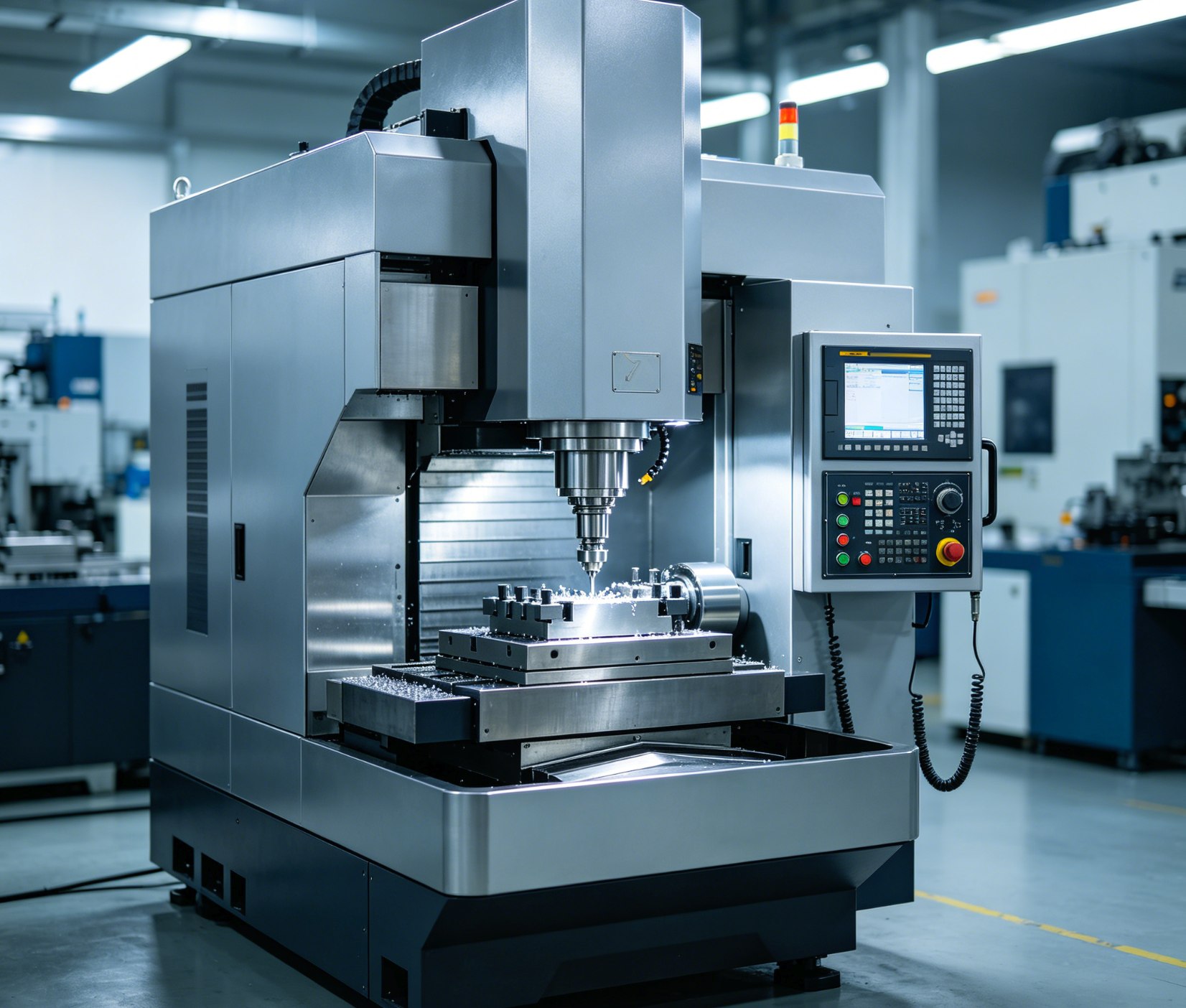
The fundamental architecture of CNC machining dictates the physical limits of what a manufacturer can produce. Traditional vertical machining centers (VMCs) typically utilize a C-frame design, which inherently restricts the size and weight of the workpiece. Gantry CNC machines resolve these limitations by employing an overhead bridge structure that spans the work table. This design decouples the machining envelope from the restrictive throat depth of a C-frame.
Manufacturers generally transition to gantry systems when handling workpieces exceeding 2,000 mm in length or weighing more than 5,000 kg. By supporting the spindle on a robust crossbeam across two columns, gantry machines distribute cutting forces symmetrically. This structural geometry prevents the deflection and vibration that would otherwise compromise dimensional accuracy on massive parts.
Production Size, Part Weight, and Workflow Needs
The decision to utilize a gantry machine often hinges on the interplay between part mass and dynamic positioning. In fixed-table gantry designs, the workpiece remains stationary while the bridge moves along the X-axis. This configuration allows the machine to support extreme table loads—often exceeding 10,000 kg per square meter—without requiring the servo motors to accelerate or decelerate the massive weight of the part. Consequently, the dynamic response of the machine remains consistent regardless of whether it is cutting a lightweight composite panel or a solid steel mold base.
Workflow requirements also dictate the adoption of large-format gantry systems. Facilities utilizing pendulum machining can partition the expansive work table into separate zones. While the spindle operates on a workpiece in one zone, operators can safely load, unload, or inspect a part in the adjacent zone. This continuous operation significantly reduces spindle downtime and improves overall equipment effectiveness (OEE).
Industries That Use Large-Format Gantry CNC Machines
The aerospace sector relies heavily on gantry CNC machines to mill structural components such as wing spars, fuselage bulkheads, and landing gear parts. These components often require continuous 5-axis machining over lengths exceeding 10 meters, demanding a work envelope that only a moving-gantry system can provide while maintaining tight aerospace tolerances.
In the energy sector, the production of wind turbine hubs, generator housings, and heat exchanger tube sheets requires heavy material removal on massive forgings. Gantry machines equipped with high-torque spindles and right-angle heads allow manufacturers to drill and mill these oversized components in a single setup. Similarly, the automotive tooling industry utilizes these machines to sculpt large stamping dies and injection molds, where superior surface finish and volumetric accuracy are critical.
Key Design Features of Gantry CNC Machines
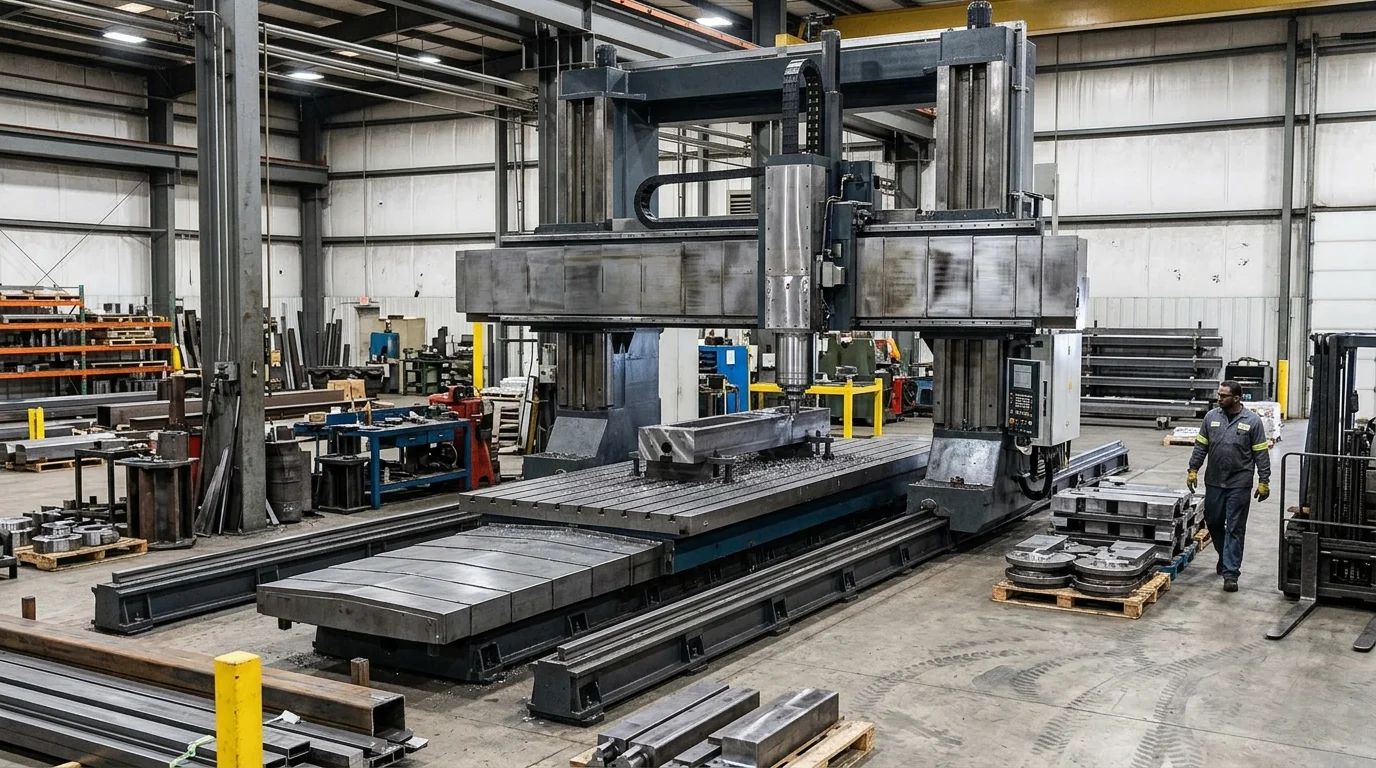
The performance of a gantry CNC machine is directly tied to its structural engineering. Unlike standard milling machines, gantry platforms must maintain rigidity across expansive spans. To achieve this, manufacturers utilize finite element analysis (FEA) to optimize the casting designs of the columns, crossbeam, and base, ensuring the machine can absorb the harmonic vibrations generated during heavy material removal.
Even with massive structural components, modern gantry machines achieve impressive dynamic performance. Advanced linear motor technology and twin-drive servo systems allow these heavy-duty machines to reach rapid traverse rates of up to 30 meters per minute, ensuring efficient tool positioning across long distances.
Bridge Structure, Travel Range, and Table Configuration
The most defining feature of a gantry machine is its bridge structure, which can be either fixed or moving. A fixed gantry (moving table) design offers superior rigidity because the bridge is rigidly anchored to the foundation. However, the X-axis travel requires the table to move back and forth, meaning the machine’s footprint must be more than double the length of its X-axis stroke. Conversely, a moving gantry design keeps the table stationary, providing a highly efficient footprint-to-travel ratio ideal for extreme lengths (often exceeding 4,000 mm in the X-axis).
| Architecture | Footprint Efficiency | Load Capacity Limit | Best Application |
|---|---|---|---|
| Moving Gantry | High (Requires stroke length + clearance) | Virtually unlimited (foundation dependent) | Aerospace spars, wind turbine blades |
| Fixed Gantry (Moving Table) | Low (Requires 2x stroke length) | Limited by servo/guideway capacity | Heavy molds, high-precision dies |
| High-Rail Gantry | Maximum (Columns integrated into facility) | Unlimited | Rail cars, massive aerospace structures |
Table configurations further customize the machine to specific workflows. T-slotted cast iron tables are standard for heavy milling, while vacuum tables are frequently integrated for securing large, flat aluminum or composite sheets in the aerospace and marine industries.
Specifications That Affect Rigidity and Accuracy
Rigidity and accuracy in large-format machining are governed by the machine’s guideways, spindle specifications, and thermal management systems. Heavy-duty applications typically require box ways (plain bearing guideways), which provide superior vibration damping and load-bearing capacity. For applications prioritizing speed and high-speed contouring, heavy-duty roller linear guideways are preferred, offering lower friction and faster acceleration.
Spindle selection also dictates the machine’s capability. Machining tough alloys requires a high-torque, gear-driven spindle (often 22 kW to 45+ kW) with a robust tool taper like BT50 or HSK-100. To maintain precision over vast travel ranges, thermal growth must be controlled. Features such as chilled ballscrews, spindle cooling jackets, and linear glass scales with a resolution of 0.001 mm are essential. When properly equipped, a high-quality gantry CNC machine can maintain a positioning accuracy of ±0.015 mm over a full 5-meter travel.
Gantry CNC Machines vs Other CNC Machine Types
Selecting the correct machine architecture requires evaluating the specific geometry and handling requirements of the parts being manufactured. While vertical machining centers (VMCs), horizontal machining centers (HMCs), and horizontal boring mills (HBMs) excel in specific scenarios, they pose severe limitations when the workpiece scales beyond their inherent design envelopes.
A standard C-frame VMC typically maxes out at around 1,500 mm to 2,000 mm of X-axis travel. Pushing a C-frame design beyond this limit results in excessive structural overhang, leading to unacceptable deflection at the spindle. Gantry machines eliminate this overhang entirely, providing a stable, supported cutting platform regardless of the X- or Y-axis position.
When a Gantry CNC Machine Is the Better Option
A gantry CNC machine is the optimal choice when dealing with parts that are exceptionally long, wide, and flat. For instance, machining a 3-meter by 2-meter aluminum vacuum table or a massive steel base plate is virtually impossible on a standard VMC due to Y-axis throat limitations. While an HBM could theoretically machine a long part, setting up a flat plate vertically on an angle plate is dangerous, time-consuming, and highly susceptible to chatter.
Furthermore, gantry machines are superior when top-down access is required for heavy components. The open-top design allows overhead bridge cranes to lower multi-ton forgings or castings directly onto the work table. This unencumbered access significantly reduces rigging time and improves safety compared to maneuvering heavy parts into the enclosed envelope of an HMC.
Core Comparison Points: Footprint, Capacity, Cost, and Precision
To clearly delineate the operational differences, it is crucial to compare gantry machines against standard VMCs and HBMs across primary facility constraints: footprint, capacity, cost, and precision.
| Machine Type | Max X-Axis Capacity | Footprint vs. Work Envelope | Base Cost Range (USD) | Typical Volumetric Precision |
|---|---|---|---|---|
| C-Frame VMC | ~2,000 mm | Moderate | $60,000 – $150,000 | Excellent on small parts |
| Horizontal Boring Mill | ~4,000+ mm | Large | $300,000 – $800,000+ | High (optimized for deep boring) |
| Moving Gantry CNC | 10,000+ mm | Highly Efficient | $250,000 – $1,000,000+ | Excellent across large flat areas |
While the initial capital expenditure for a gantry CNC machine is high, its footprint efficiency is unparalleled for long parts. A moving gantry machine only requires floor space slightly larger than its maximum X-axis stroke, whereas moving-table VMCs and fixed gantries require double the floor space to accommodate table travel. Precision on a gantry is optimized for planar accuracy over large areas, making it superior for contouring massive dies compared to an HBM, which is optimized for deep-hole alignment and multi-sided access.
How to Select and Implement a Gantry CNC Machine
Procuring a large-format gantry CNC machine is a complex engineering project that extends well beyond the purchase order. Unlike smaller VMCs that can be delivered, leveled, and powered up within a few days, gantry systems require rigorous facility preparation and precise logistical coordination.
The implementation timeline for a custom or semi-custom gantry machine frequently spans 6 to 12 months. This lead time is necessary not only for the manufacturing of the machine but also to execute the extensive site preparations required to support equipment that can weigh upwards of 40,000 kg.
Evaluating Workpiece Size, Materials, and Tolerance Needs
The selection process begins with a rigorous analysis of the maximum workpiece dimensions and the specific materials to be cut. Material dictates the required spindle torque and speed; high-speed aluminum routing requires 20,000+ RPM spindles, whereas machining Inconel or hardened tool steel demands high-torque, low-RPM geared spindles. The Z-axis clearance (the distance between the spindle nose and the table) must also be carefully calculated to accommodate the tallest anticipated part plus the length of the longest cutting tool and tool holder.
Tolerance requirements directly impact the required machine specifications. If a facility requires aerospace-grade tolerances over a 6-meter span, the machine must be specified with volumetric error compensation, linear glass scales, and comprehensive thermal control systems. These precision-enhancing features can increase the base price of the machine by 15% to 30%, making it critical to align the machine’s specifications strictly with engineering requirements rather than theoretical maximums.
Sourcing, Installation, Maintenance, and Training
Installation of a gantry CNC machine almost universally requires specialized foundation work. Facilities must typically excavate the existing floor and pour an isolated, steel-reinforced concrete foundation ranging from 500 mm to over 1,000 mm in thickness. This foundation requires a minimum curing time of 28 days before the machine can be anchored and laser-calibrated. Failure to provide an adequate foundation will result in machine settling, permanently compromising geometric accuracy.
Once installed, maintenance and training protocols must scale with the machine’s complexity. Preventative maintenance programs must include regular verification of the twin-drive synchronization (to prevent gantry skewing), chiller system inspections, and automated lubrication checks. Furthermore, operator training is critical. Because a crash on a large gantry machine can result in catastrophic spindle damage and tens of thousands of dollars in repair costs, operators must be thoroughly trained in advanced toolpath simulation and collision avoidance software prior to running live parts.
How to Decide if a Gantry CNC Machine Fits Your
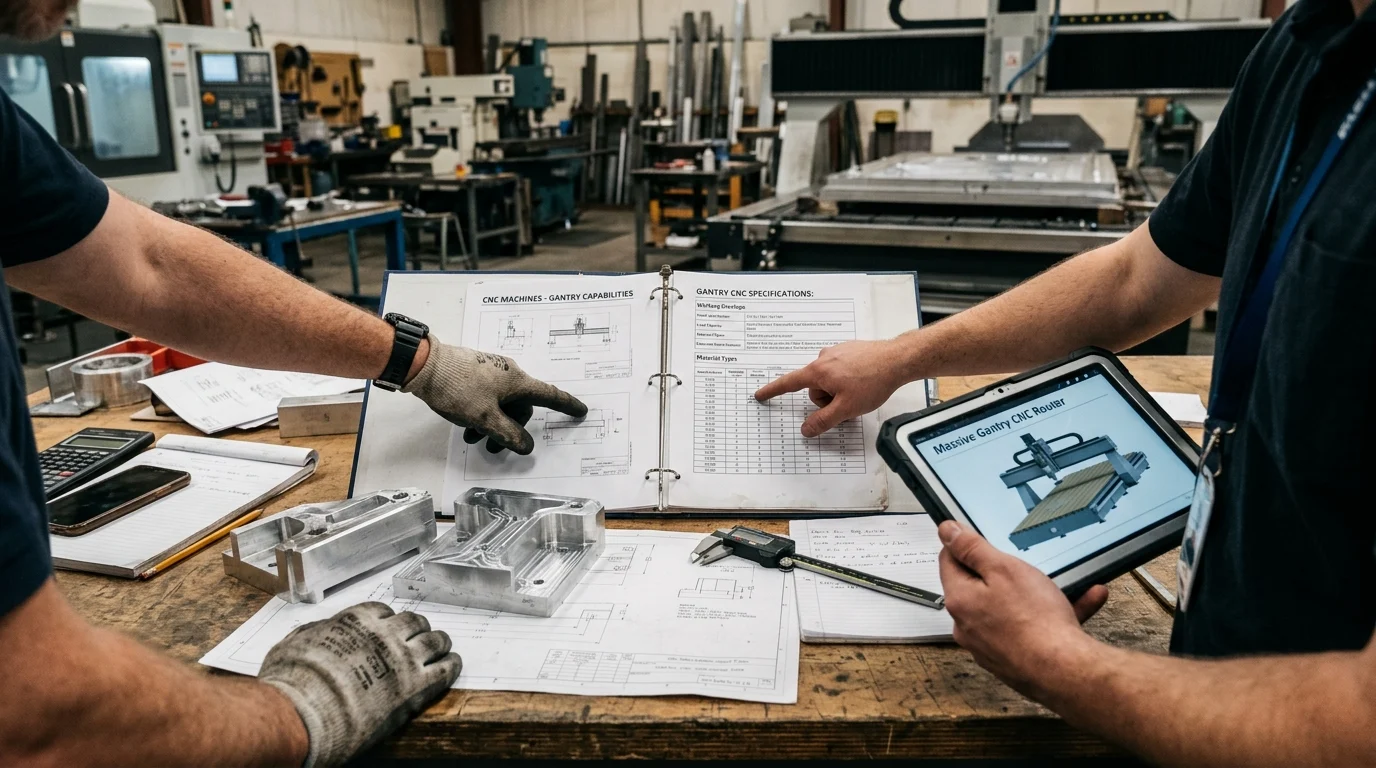
Determining whether a gantry CNC machine is a sound capital investment requires a comprehensive analysis of production bottlenecks, outsourcing costs, and long-term business strategy. These machines represent a major financial commitment, often requiring an initial investment exceeding $300,000, exclusive of facility modifications and advanced tooling.
Financial justification typically relies on achieving high utilization rates. Industry benchmarks suggest that a large-format gantry machine must maintain a utilization rate of at least 70% to deliver a competitive return on investment (ROI) within a standard 3- to 5-year depreciation schedule. Facilities must evaluate whether their current or projected order volume can sustain this level of operation.
Decision Criteria for Large Workpiece Machining
The primary decision criterion is the cost and risk associated with current large-part manufacturing methods. Facilities currently sub-contracting large platens, frames, or molds must calculate the annual expenditure on these outsourced services, factoring in the hidden costs of logistical delays, shipping expenses, and loss of quality control. If the annualized cost of outsourcing approaches the financing cost of a gantry machine, bringing the capability in-house becomes strategically viable.
Another critical criterion is setup efficiency.
Key Takeaways
- The most important conclusions and rationale for CNC Machines
- Specs, compliance, and risk checks worth validating before you commit
- Practical next steps and caveats readers can apply immediately
Frequently Asked Questions
When should a manufacturer choose a gantry CNC machine?
Choose a gantry CNC machine when parts are typically over 2,000 mm long, above 5,000 kg, or need stable accuracy during heavy cutting.
Why are gantry CNC machines better for large workpieces?
Their bridge structure spreads cutting forces across two columns, reducing deflection and vibration for better rigidity, accuracy, and surface finish on oversized parts.
Which gantry design is better: moving gantry or fixed gantry?
Moving gantry suits very long parts and saves floor space. Fixed gantry offers higher rigidity for precision heavy-duty mold and die machining.
What industries commonly use gantry CNC machines?
Aerospace, energy, and automotive tooling use them for wing structures, turbine components, generator housings, large dies, and injection molds.
Can OTURN Machinery help with gantry CNC solutions for heavy metalworking parts?
Yes. OTURN supplies gantry and double-column CNC machines with rigid structures, rich configurations, and overseas support for molds, aerospace, valve, and other large-part applications.
Post time: Apr-22-2026