


Why CNC Machines Matter in Automotive Parts Manufacturing
The automotive industry operates under some of the most stringent manufacturing standards globally, driven by the necessity for passenger safety, fuel efficiency, and mechanical reliability. At the core of this production ecosystem are CNC (Computer Numerical Control) machines, which translate digital blueprints into physical components with exceptional precision. Compliance with frameworks such as IATF 16949 dictates that automotive parts manufacturers maintain rigorous process control, a requirement that modern CNC technology fulfills through automated, highly repeatable machining cycles.
As vehicles transition toward electrification and advanced driver-assistance systems (ADAS), the demand for lightweight, complex components has surged. CNC machining provides the necessary versatility to process diverse materials, ranging from high-strength steel alloys for drivetrain components to advanced aluminum matrix composites for electric vehicle (EV) battery enclosures.
Cycle time, part complexity, and quality requirements
In high-volume automotive environments, cycle time is a critical metric directly linked to profitability. Manufacturers continuously optimize toolpaths and cutting parameters to shave seconds off cycle times, as saving even 15 seconds per part yields substantial gains over a production run of 100,000 units. Advanced CNC machines achieve rapid traverse rates exceeding 60 meters per minute (m/min) and chip-to-chip tool change times under 2.5 seconds, effectively minimizing non-cutting time.
Part complexity and quality requirements further justify the reliance on top-tier CNC equipment. Engine and transmission components frequently require geometrical tolerances tighter than ±0.005 mm and surface finishes of Ra 0.4 µm or better. Achieving these specifications demands machines with superior thermal stability and vibration-damping characteristics, ensuring that dynamic forces generated during heavy material removal do not compromise part dimensions or surface integrity.
Automotive part categories best suited for CNC machining
Certain automotive components are inherently suited for CNC machining due to their complex geometries and strict functional requirements. Powertrain components, including engine blocks, cylinder heads, and transmission housings, represent a significant portion of CNC-machined parts. These items often require simultaneous 4- or 5-axis machining to access deep cavities, compound angles, and intricate fluid galleries without repositioning the workpiece.
Beyond the powertrain, suspension components such as steering knuckles, control arms, and brake calipers require the precision of CNC milling and turning. As the industry shifts toward electric vehicles, CNC machines are increasingly tasked with producing stator housings, motor shafts, and complex thermal management plates. These EV components often utilize thin-walled aluminum structures, requiring specialized high-speed machining strategies to prevent material deformation during the cutting process.
What Defines the Best CNC Machines for Automotive Parts
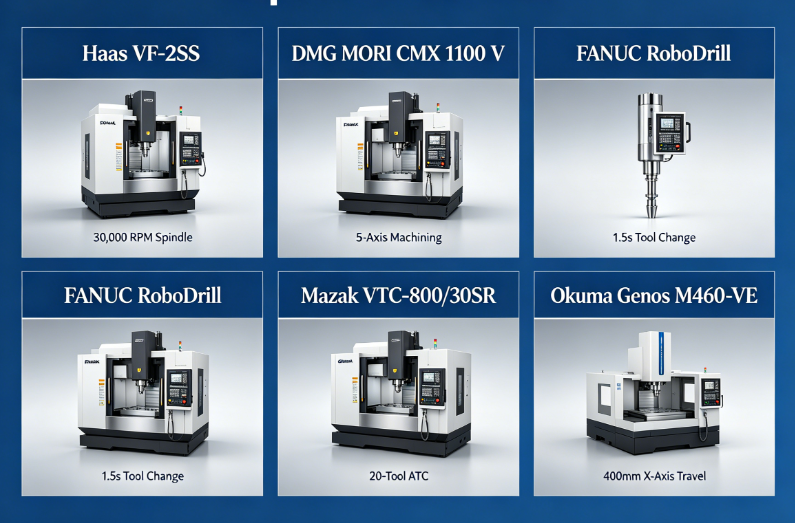
Identifying the optimal CNC machine for automotive applications requires evaluating a combination of kinematic configuration, mechanical rigidity, and control sophistication. Top-tier machines are not merely metal-cutting devices; they are integrated manufacturing cells capable of sustained, untended operation in harsh industrial environments.
Machine configurations used in automotive production
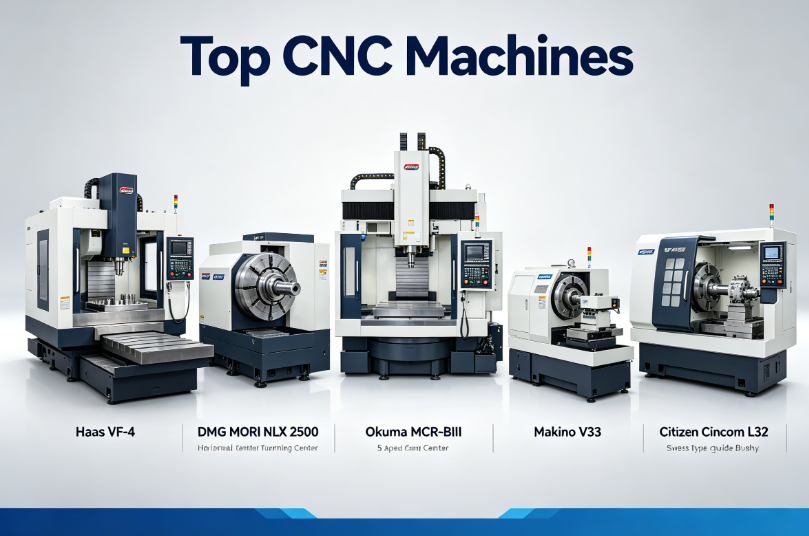
Automotive production floors predominantly utilize three machine configurations: Horizontal Machining Centers (HMCs), 5-axis Vertical Machining Centers (VMCs), and multi-tasking mill-turn lathes. HMCs are the industry standard for high-volume production of engine blocks and transmission cases. Their horizontal spindle orientation facilitates natural chip evacuation, preventing chip recutting and prolonging tool life. Furthermore, HMCs are typically equipped with automatic pallet changers (APCs), allowing operators to load raw material while the machine simultaneously processes another part.
Multi-tasking machines, which combine turning and milling capabilities, are essential for producing complex rotational parts like crankshafts and gear shafts in a single setup. This “done-in-one” approach eliminates work-in-progress (WIP) inventory between discrete turning and milling operations, significantly reducing cumulative tolerance errors.
| Machine Configuration | Primary Automotive Application | Typical Cycle Volume | Key Advantage |
|---|---|---|---|
| Horizontal Machining Center (HMC) | Engine blocks, transmission housings | High (>50,000 units/yr) | Excellent chip evacuation, pallet integration |
| 5-Axis Vertical Machining Center | Impellers, complex suspension parts | Medium to High | Reduced setups, complex contouring |
| Mill-Turn Multi-Tasking Lathe | Crankshafts, camshafts, drive shafts | Medium to High | Done-in-one processing, high concentricity |
Spindle power, rigidity, accuracy, and tooling considerations
The heart of any CNC machine is its spindle. For machining lightweight automotive alloys like aluminum 6061 or 7075, high-speed spindles ranging from 12,000 to 24,000 RPM are necessary to achieve optimal surface cutting speeds. Conversely, machining forged steel or cast iron requires high-torque gear-driven spindles capable of delivering over 300 Nm of torque at lower RPMs to endure heavy roughing cuts.
Rigidity and thermal stability are equally paramount. Top CNC machines utilize heavily ribbed cast iron or polymer concrete bases to absorb cutting vibrations. Additionally, active thermal compensation systems use sensors distributed across the machine casting and spindle to offset thermal expansion, ensuring volumetric accuracy remains within a 10-micron band even during 24/7 operation. Tooling considerations also play a major role; large-capacity tool magazines (60 to 120+ pockets) and high-pressure Coolant Through Spindle (CTS) systems operating at 70 to 100 bar are standard requirements for deep-hole drilling and extended unmanned production.
How to Compare CNC Machines by Cost and Performance
Procuring CNC machinery for automotive parts manufacturing involves a complex financial analysis balancing upfront capital expenditure (CapEx) against long-term operational expenditure (OpEx). While high-performance machines command premium prices, their superior throughput and reliability often yield a lower cost per part over the equipment’s lifespan.
Key criteria for machine comparison
When comparing CNC machines, procurement engineers must evaluate kinematic performance metrics alongside volumetric accuracy. Key comparison points include rapid traverse rates, acceleration/deceleration profiles (often measured in G-force, with high-end linear motor machines exceeding 1.5 G), and control processing speeds. A machine equipped with a state-of-the-art CNC control capable of processing 5,000 blocks per second will execute complex 3D toolpaths far more smoothly than a legacy control, directly impacting surface finish and cycle time.
Another critical criterion is automation readiness. Machines designed with standard interfaces for robotic loading, automated part probing, and hydraulic fixture clamping provide a scalable pathway for high-volume automotive production. Comparing the integration costs of these features across different machine tool builders is essential for accurate capital budgeting.
Total cost of ownership, maintenance, and energy use
The Total Cost of Ownership (TCO) for a production-grade CNC machine extends far beyond its initial purchase price, which can range from $150,000 for a standard 3-axis VMC to over $800,000 for a fully equipped multi-tasking center. Maintenance costs typically account for 2% to 5% of the machine’s CapEx annually. Unplanned downtime in an automotive supply chain can result in severe penalties, making preventative maintenance features and predictive spindle-wear monitoring highly valuable.
Energy consumption is an increasingly scrutinized component of OpEx. Spindles, coolant pumps, and chip conveyors draw significant power. Modern CNC machines utilize regenerative drive systems that capture kinetic energy during spindle deceleration, feeding it back into the facility’s power grid. These systems, combined with variable frequency drives (VFDs) on high-pressure coolant pumps, can reduce overall machine energy consumption by 15% to 30%.
| Cost Category | Estimated Percentage of TCO (10-Year Lifespan) | Key Drivers and Considerations | |
|---|---|---|---|
| Initial CapEx (Machine & Automation) | 35% – 45% | Base machine price, robot cells, pallet systems, custom fixturing | |
| Tooling and Consumables | 20% – 30% | Carbide inserts, end mills, cutting fluids, filtration media | |
| Maintenance and Repairs | 10% – 15% | Spindle rebuilds, ball screw replacement, preventative maintenance labor | |
| Energy Consumption | 10% – 15% | Spindle continuous load, high-pressure coolant pumps, HVAC for climate control |
How to Select and Implement CNC Machines Successfully
Successful deployment of a CNC machine in an automotive facility requires meticulous planning, from initial vendor negotiations to final integration on the shop floor. A poorly executed installation can delay production launches, leading to missed delivery windows and compromised part quality.
Sourcing, factory acceptance testing, and setup steps
The sourcing process must culminate in a rigorous Factory Acceptance Test (FAT) performed at the machine builder’s facility before shipment. For automotive applications, a standard FAT involves machining a representative batch of parts (e.g., 30 to 50 units) to conduct a statistical process control (SPC) study. The machine must typically demonstrate a Process Capability Index (Cpk) greater than 1.67 on critical dimensions, proving its ability to hold tolerances well within the specified limits.
Upon delivery, the setup phase requires extreme precision. The machine foundation must meet the builder’s concrete depth and curing specifications to prevent settling. Riggers and technicians must level the machine to strict tolerances, often within 0.01 mm per meter, using precision machinist levels. Following physical installation, laser interferometry and ballbar testing are conducted to verify linear positioning accuracy, repeatability, and simultaneous multi-axis interpolation before the machine is released for production.
Software integration, traceability, and workflow fit
In modern smart factories, a CNC machine must seamlessly integrate with the facility’s digital infrastructure. Compatibility with standardized communication protocols, such as MTConnect or OPC UA, is mandatory for streaming real-time machine data to Manufacturing Execution Systems (MES) and Enterprise Resource Planning (ERP) software. This integration enables production managers to monitor Overall Equipment Effectiveness (OEE), track spindle utilization, and log alarm histories remotely.
Traceability is another non-negotiable requirement in automotive manufacturing. CNC machines are frequently paired with automated laser marking systems and inline probing routines. Data from the machine’s probe can be tied to a specific part’s serial number or data matrix code, ensuring that the exact dimensions recorded during the machining cycle are archived. This digital thread provides critical liability protection and quality assurance, ensuring compliance with automotive traceability mandates.
Decision Framework for Choosing the Right CNC Machine
Selecting the right CNC machine is a strategic decision that shapes an automotive manufacturer’s competitive edge. A structured decision framework ensures that capital investments align with both immediate production requirements and long-term business objectives.
Matching machines to prototyping and production needs
The first step in the framework is delineating the machine’s primary function: prototyping versus high-volume production. Automotive R&D departments or specialized race-team suppliers often prioritize flexibility over raw throughput. In these scenarios, a 5-axis VMC with a diverse tool matrix and conversational programming capabilities is ideal for producing low-volume, highly complex prototypes.
Conversely, Tier 1 and Tier 2 automotive suppliers fulfilling contracts with Minimum Order Quantities (MOQs) exceeding 100,000 units per year require dedicated production solutions. For these environments, the framework points toward twin-pallet HMCs or automated cellular manufacturing systems. The focus shifts entirely to cycle time reduction, tool life management, and minimizing human intervention, justifying the higher initial capital outlay through massive economies of scale.
Final selection criteria for suppliers and long-term value
Beyond technical specifications, the final selection criteria must heavily weight the machine tool builder’s support infrastructure and Service Level Agreements (SLAs). In the automotive sector, where just-in-time (JIT) manufacturing is prevalent, machine downtime is catastrophic. Buyers must evaluate the supplier’s guaranteed response times, spare parts availability, and local technician density. A supplier offering a 24-hour spindle replacement guarantee and holding 95% of critical spare parts in domestic inventory presents significantly less risk than a vendor with a sparse support network.
Ultimately, the long-term value of a CNC machine is defined by its operational longevity and adaptability. Machines built with scalable control architectures and robust mechanical foundations can be retooled and repurposed for future automotive programs. By systematically evaluating application requirements, total cost of ownership, and vendor support, manufacturers can secure CNC technology that drives precision, efficiency, and profitability in the demanding automotive sector.
Key Takeaways
- The most important conclusions and rationale for Top CNC Machines
- Specs, compliance, and risk checks worth validating before you commit
- Practical next steps and caveats readers can apply immediately
Frequently Asked Questions
Which CNC machine is best for automotive housings and engine blocks?
A horizontal machining center is usually best. It improves chip evacuation, supports pallet changers, and fits high-volume machining of engine blocks, transmission housings, and similar cast parts.
When should automotive manufacturers choose a 5-axis machining center?
Choose 5-axis when parts have deep cavities, compound angles, or multiple faces. It reduces setups and helps machine steering knuckles, EV housings, molds, and complex aluminum components more efficiently.
Why use a mill-turn CNC machine for shafts and crankshafts?
Mill-turn machines combine turning and milling in one setup. This improves concentricity, cuts handling time, and is practical for crankshafts, camshafts, gear shafts, and other rotational automotive parts.
What should buyers compare besides price when selecting a CNC machine?
Check rigidity, spindle power, accuracy, tool capacity, chip control, automation options, and service support. For automotive work, stable repeatability and faster ROI usually matter more than the lowest purchase price.
How can OTURN Machinery support automotive parts manufacturers?
OTURN provides CNC lathes, turning centers, machining centers, 5-axis machines, and special-purpose solutions, plus overseas support. This helps manufacturers build efficient lines with lower investment risk and faster returns.
Post time: Apr-22-2026