


Why CNC Slant Bed Lathes Matter for Aerospace Manufacturing
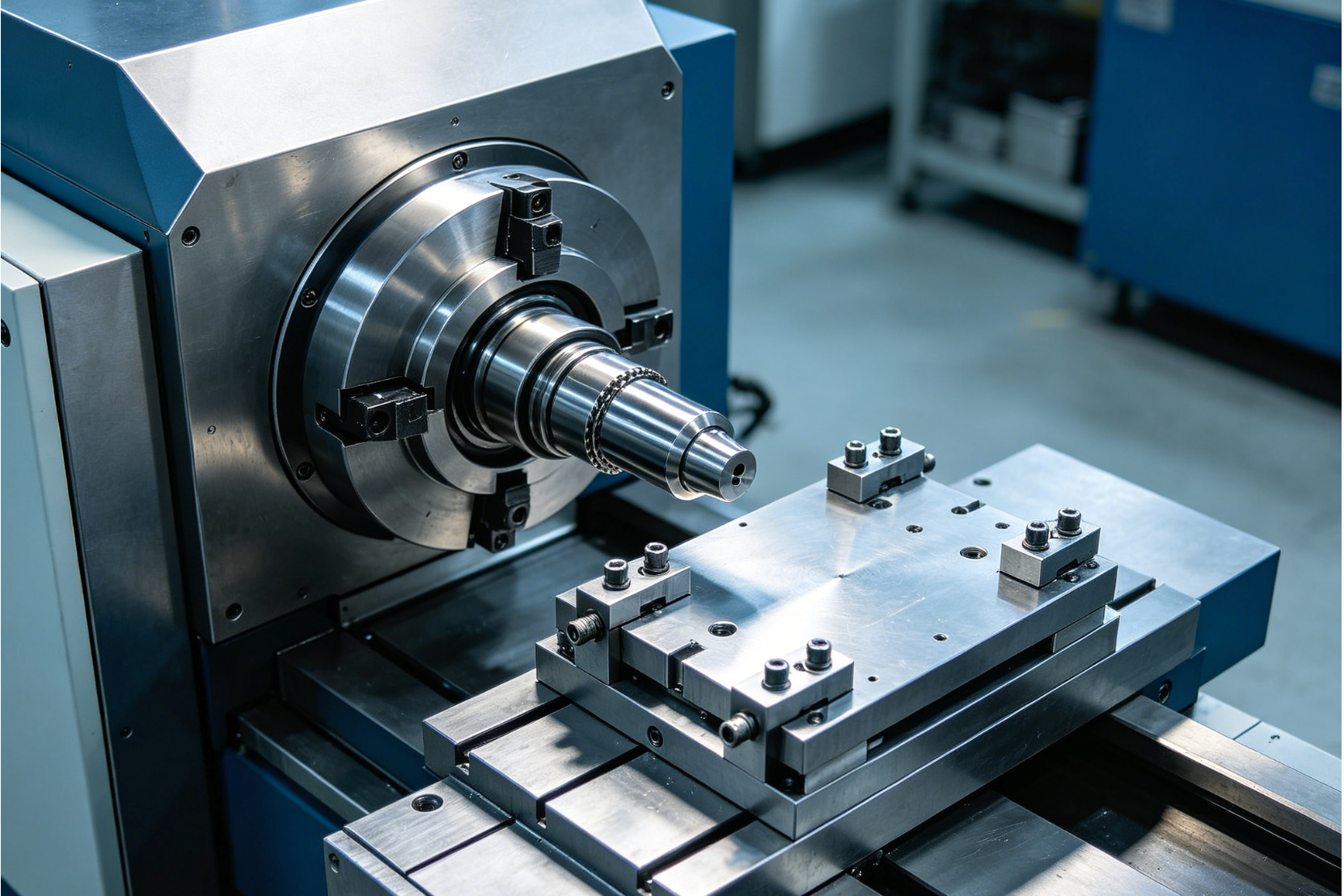
The adoption of CNC slant bed lathes has fundamentally shifted how aerospace and automotive tier-one suppliers approach turning operations. Unlike traditional flat-bed architectures, the slant bed design—typically engineered at 30, 45, or 60-degree angles—lowers the machine’s center of gravity and significantly shortens the distance between the cutting tool and the guideways. This geometric advantage translates directly into enhanced structural rigidity, which is a non-negotiable requirement when machining the high-tensile superalloys and complex geometries prevalent in aerospace manufacturing.
How they improve precision and throughput
Slant bed architectures inherently dampen cutting vibrations, allowing manufacturers to maintain tight tolerances even during aggressive material removal. By utilizing linear or heavy-duty box guideways mounted on a single-piece cast iron bed, these lathes can consistently achieve positioning accuracies of ±0.002 mm and surface finishes down to Ra 0.4 μm. Furthermore, spindle speeds reaching up to 5,000 RPM, coupled with rapid turret indexing times of under 0.2 seconds, drastically reduce non-cutting time, thereby increasing overall throughput for high-value production runs.
Which aerospace components are best suited
The aerospace sector relies heavily on materials like Inconel 718, titanium alloys (Ti-6Al-4V), and specialized stainless steels, all of which are notoriously difficult to machine. CNC slant bed lathes excel in producing critical rotational components such as turbine engine shafts, hydraulic valve bodies, landing gear pins, and high-strength aerospace fasteners. The superior rigidity of the slant bed prevents tool deflection during heavy interrupted cuts, ensuring dimensional stability across long production batches of these mission-critical parts.
What Technical Specifications Buyers Should Compare

Procurement teams must evaluate a stringent set of mechanical and electronic specifications to ensure a CNC slant bed lathe meets their facility’s operational demands. A superficial comparison of base prices often overlooks the technical parameters that dictate long-term reliability, tool life, and overall equipment effectiveness (OEE).
Which machine parameters matter most
Core specifications dictate the physical envelope and cutting capacity of the lathe. Buyers should prioritize the swing over bed (typically ranging from 400 mm to 600 mm for standard automotive parts), the maximum turning diameter, and the maximum turning length. Spindle motor power is equally critical; an 11 kW to 22 kW continuous rating is generally required for heavy-duty automotive and aerospace applications. Additionally, rapid traverse rates on the X and Z axes—often reaching 30 m/min on modern linear guideway models—serve as a strong indicator of the machine’s efficiency in minimizing idle time.
How rigidity, thermal stability, and chip evacuation affect performance
The angle of the slant bed directly influences thermal stability and chip management. A true 45-degree or 60-degree slant bed allows gravity to facilitate natural chip flow directly into the chip conveyor, preventing thermal buildup inside the machining envelope. This efficient chip evacuation is critical during continuous automotive production runs, where accumulated hot chips can cause localized thermal expansion and compromise dimensional accuracy. High-grade Meehanite cast iron bases further enhance performance by providing superior vibration dampening compared to fabricated steel alternatives.
How to build a practical comparison matrix
To streamline the evaluation process, procurement engineers should construct a technical comparison matrix that weighs architectural differences against production requirements.
| Bed Architecture | Chip Evacuation Efficiency | Typical Z-Axis Rapid Rate | Ideal Application Profile |
|---|---|---|---|
| True 45° Slant Bed | Excellent (Gravity assisted) | 24 – 30 m/min | High-volume automotive, aerospace superalloys |
| 30° Slant Bed | Good | 20 – 24 m/min | Medium-duty general precision turning |
| Traditional Flat Bed | Poor (Requires manual/coolant flush) | 10 – 15 m/min | Heavy, low-speed shaft turning, lower budget |
How to Evaluate CNC Slant Bed Lathe Suppliers
Sourcing capital equipment requires a rigorous vetting process of the manufacturer’s operational capabilities and commercial reliability. Partnering with established global marketing and sales centers, such as OTURN Machinery, can provide B2B buyers with streamlined access to high-quality manufacturing facilities while mitigating cross-border procurement risks.
Which factory qualifications and commercial terms to review
Vendor validation should begin with a review of factory certifications, primarily ISO 9001 for quality management and ISO 14001 for environmental compliance. Buyers should inquire about the manufacturer’s monthly production capacity; verifying an output of 50 to 100 units per month indicates a mature, scalable operation. Standard commercial terms in the machine tool trade typically involve a 30% T/T deposit to initiate production, with the remaining 70% balance required after successful factory acceptance testing (FAT) but prior to shipment.
How to assess packaging, installation, and after-sales support
Improper packaging is a leading cause of transit damage for precision machinery. Buyers must mandate export-grade packaging, which includes vacuum-sealed aluminum foil with desiccants to prevent maritime rust, housed within heavy-duty fumigated wooden crates. Post-delivery, the supplier’s after-sales infrastructure is paramount. A reliable partner should offer remote diagnostics, detailed English-language maintenance manuals, and a guarantee of local technician dispatch or critical parts availability within 48 to 72 hours.
How to estimate total landed cost
Calculating the total landed cost is essential for accurate capital expenditure planning. Beyond the FOB or CIF price of the lathe, procurement teams must account for destination customs duties, which typically range from 4% to 5% for CNC lathes under HS code 8458.11, depending on the importing country’s trade agreements. Additional expenses include inland freight, specialized rigging at the facility, and the cost of commissioning and operator training.
Which Compliance, Quality, and Delivery Factors Matter Most
Ensuring that imported CNC slant bed lathes meet stringent international compliance and quality standards is vital for operational safety and seamless customs clearance. Regulatory adherence protects the buyer from costly port delays and workplace safety liabilities.
What documentation and inspection standards to require
A comprehensive documentation package should accompany every machine delivery. Buyers must require verifiable inspection reports, including Renishaw ballbar testing and laser interferometer calibration data, which confirm positioning accuracy and repeatability. For aerospace applications, spindle runout must be documented and certified to be below 0.003 mm to guarantee the required concentricity on finished rotational components.
How to verify CE, electrical compliance, and traceability
For buyers in the European Economic Area, the machine must bear a legitimate CE mark, demonstrating compliance with the Machinery Directive 2006/42/EC and the Electromagnetic Compatibility (EMC) Directive. Electrical cabinets must be rigorously inspected for adherence to IP54 or IP65 ingress protection standards, ensuring critical electronics are shielded from coolant mist and conductive metallic dust. Full component traceability, utilizing globally recognized brands for CNC controllers and linear guideways, is also a mandatory requirement for long-term maintainability.
How to reduce transit and commissioning risks
Transit and commissioning risks can be systematically reduced through proactive measures. Conducting a Pre-Shipment Inspection (PSI) via a third-party agency provides independent verification of machine condition before containerization. Attaching shock indicators, such as ShockWatch or TiltWatch labels, to the exterior crates deters rough handling by freight forwarders and provides immediate evidence for insurance claims if drops occur. Factoring in standard manufacturing lead times of 45 to 90 days allows buyers to synchronize delivery with facility readiness, avoiding costly warehouse storage fees.
How Buyers Can Build a Reliable Sourcing Process
Establishing a reliable sourcing process empowers procurement teams to transition from transactional purchasing to strategic equipment lifecycle management. A structured approach ensures that the selected CNC slant bed lathes deliver the expected return on investment (ROI) within the projected payback period.
How to shortlist and validate suppliers
Shortlisting suppliers requires moving beyond glossy brochures to evaluate empirical performance data. Buyers should request unedited machining videos demonstrating the lathe cutting materials identical to their production needs. Analyzing case studies and requesting reference contacts from existing tier-one automotive or aerospace clients provides invaluable insights into the machine’s real-world uptime and the supplier’s responsiveness to warranty claims.
How to align machine selection with production goals
Ultimately, the selected machine configuration must align perfectly with the facility’s specific production goals. Over-specifying inflates capital expenditure, while under-specifying causes bottlenecks.
| Production Environment | Recommended Lathe Configuration | Target Cycle Time Reduction | Estimated ROI Timeframe |
|---|---|---|---|
| High-Volume Automotive (e.g., wheel hubs) | Slant bed with automated gantry loader & dual turrets | 30% – 40% | 18 – 24 months |
| Complex Aerospace (e.g., turbine shafts) | Y-axis milling capability + sub-spindle | 20% – 25% | 24 – 36 months |
| High-Mix, Low-Volume Job Shop | Standard 45° slant bed with programmable tailstock | 10% – 15% | 12 – 18 months |
By matching technical capabilities—such as live tooling or automation integration—with volume requirements, B2B buyers can secure a scalable metalworking solution that maintains global competitiveness.
Key Takeaways
- Wholesale sourcing and supply-chain implications for CNC Slant Bed Lathes
- Specifications, compliance, and commercial terms buyers should validate
- Actionable recommendations for distributors and procurement teams
Frequently Asked Questions
Why are CNC slant bed lathes preferred for aerospace parts?
Their rigid slant-bed structure reduces vibration and tool deflection, helping maintain tight tolerances on titanium, Inconel, and stainless aerospace components such as shafts, pins, and valve bodies.
Which specifications should buyers compare first?
Start with swing over bed, max turning diameter and length, spindle power, guideway type, rapid traverse speed, and achievable accuracy. These directly affect capacity, cycle time, and machining stability.
How does a 45° or 60° slant bed improve production?
It improves gravity-assisted chip evacuation, reduces heat buildup, and supports stable cutting. This is especially useful for long automotive runs and difficult aerospace materials.
What components are well suited to CNC slant bed lathes?
They are ideal for rotational parts such as turbine shafts, landing gear pins, hydraulic valve bodies, wheel hubs, crankshafts, and high-strength fasteners requiring repeatable precision.
How can OTURN Machinery help buyers source the right slant bed lathe?
OTURN connects buyers with qualified Chinese group factories, offers machine options for precision and heavy-duty turning, and supports overseas customers with practical sales and service coordination.
Post time: Apr-20-2026