


Introduction
Choosing a CNC machining center for precision parts requires more than comparing travel range, spindle speed, or price. The right machine must match the tolerances, materials, part geometry, and production volumes your operation demands, because those factors directly affect accuracy, surface finish, uptime, and throughput. A poor fit can introduce vibration, thermal instability, and process bottlenecks that raise scrap rates and operating costs. This article outlines the key criteria to evaluate—from machine structure and motion performance to automation compatibility and long-term support—so you can make a procurement decision that supports both immediate production needs and future manufacturing goals.
How should manufacturers approach CNC machining center selection for pre
Procuring a CNC machining center for precision parts is a capital-intensive decision that dictates a manufacturing facility’s baseline capabilities. For industries such as aerospace, medical device manufacturing, and semiconductor equipment, the margin for error is virtually nonexistent. Approaching this selection requires moving beyond basic dimensional capacity to evaluate how machine architecture fundamentally interacts with specific material properties and production workflows.
A structured procurement approach aligns capital expenditure with strategic manufacturing goals. By defining exact part parameters, tolerances, and volume expectations before engaging machine builders, manufacturers can filter out inappropriate technologies early in the evaluation cycle.
Why does the right CNC machining center affect part
quality and throughput?
The correlation between machine architecture and part quality is undeniable. A properly specified CNC machining center minimizes harmonic vibrations and thermal deformation, which are the primary culprits behind out-of-tolerance features. For precision components requiring geometric dimensioning and tolerancing (GD&T) profiles within ±0.002 mm, the machine’s dynamic stiffness is paramount.
Furthermore, throughput is directly tied to the machine’s ability to maintain high feed rates without sacrificing surface finish. Advanced vibration damping and optimized servomotor tuning allow operators to maximize material removal rates. Upgrading to a machine with superior structural integrity often improves overall yield by 15% to 30% compared to legacy equipment, drastically reducing scrap rates on high-value alloys.
Which production scenarios require different CNC machining cente
r configurations?
Production volumes and part complexity dictate the architectural requirements of the machining center. High-mix, low-volume (HMLV) environments demand exceptional flexibility, making 5-axis continuous or 3+2 positional machines highly desirable to reduce setup times and manage complex geometries efficiently.
Conversely, low-mix, high-volume (LMHV) scenarios prioritize rapid material removal and automation integration. These environments frequently favor horizontal machining centers (HMCs) equipped with multi-station pallet pools and robust chip evacuation systems. Selecting the wrong configuration can lead to severe bottlenecks, such as excessive fixture swapping on a vertical machine when a horizontal configuration would have provided uninterrupted spindle uptime.
What technical specifications matter most when choosing a CNC machining
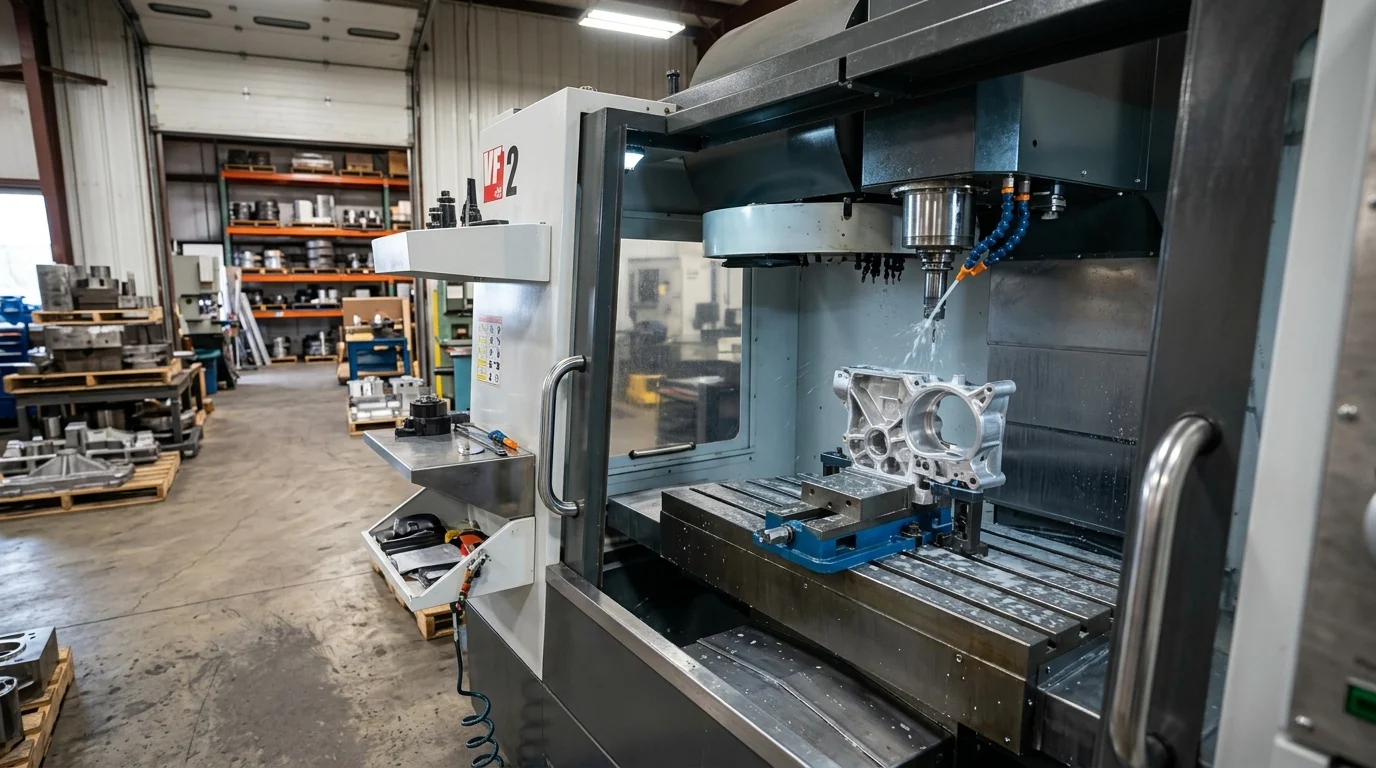
Translating production requirements into technical specifications requires a rigorous analysis of the CNC machining center’s mechanical and electronic subsystems. Every component, from the spindle bearings to the servomotors, must be evaluated against the demands of the intended applications.
How should buyers evaluate spindle speed, torque, axis configura
tion, and rigidity?
Spindle dynamics and structural rigidity form the foundation of precision cutting. High-speed machining of aluminum aerospace components may require a direct-drive spindle operating at 24,000 to 30,000 RPM to maintain optimal surface footage. In contrast, machining titanium alloys necessitates a high-torque, gear-driven spindle capable of delivering over 300 Nm of torque at lower speeds to power through tough materials without stalling.
Axis configuration must also align with part geometry and cutting forces. Heavy-duty box ways provide superior vibration damping for heavy roughing, while linear guideways offer the rapid acceleration needed for complex 3D contouring.
| Spindle Drive Type | Typical RPM Range | Peak Torque Profile | Ideal Material Application |
|---|---|---|---|
| Belt-Driven | 8,000 – 12,000 | Medium | General purpose steel, aluminum |
| Direct-Drive (Inline) | 12,000 – 24,000 | Low to Medium | High-speed aluminum, fine finishing |
| Gear-Driven | 4,000 – 8,000 | Very High (>300 Nm) | Titanium, Inconel, heavy roughing |
| Motorized (Electro-spindle) | 15,000 – 40,000+ | Low | Micromachining, medical implants |
Which accuracy, thermal stability, and control system factors ma
tter most?
For precision parts, volumetric accuracy and thermal stability are non-negotiable. Buyers must evaluate the machine’s active thermal compensation systems, which utilize strategically placed sensors to adjust for casting expansion during a 24-hour production cycle. High-end systems can maintain thermal drift below 3 µm regardless of ambient shop floor fluctuations.
Additionally, the inclusion of absolute glass scales on linear axes provides direct position feedback, eliminating errors caused by ball screw thermal expansion. The CNC control system itself must offer high-speed look-ahead processing—often capable of processing 1,000 to 5,000 blocks per second—to execute complex, multi-axis toolpaths smoothly without data starvation or surface gouging.
What comparison criteria should buyers use to evaluate CNC
machining centers?
Evaluating these specifications requires a standardized comparison matrix. Buyers should benchmark competing machines based on ISO 230-2 standards for positioning accuracy and repeatability. It is critical to compare data accurately by ensuring that quoted accuracies are measured under identical environmental conditions and payload states.
Furthermore, comparing finite element analysis (FEA) data provided by machine builders can reveal how different cast iron, polymer composite, or mineral cast beds handle structural deflection under maximum cutting loads. True comparison looks past marketing claims to the underlying engineering data governing machine behavior.
How can buyers compare CNC machining center productivity, automation, an
Beyond raw cutting capability, the financial viability of a CNC machining center hinges on its operational efficiency and total lifecycle costs. A machine that cuts exceptionally well but suffers from prolonged setup times or excessive maintenance will ultimately erode profit margins.
Which indicators best measure productivity and automation perfor
mance?
Productivity is best measured through metrics such as Overall Equipment Effectiveness (OEE) and non-cutting time reductions. Key indicators include chip-to-chip tool change times—ideally under 2.5 seconds for high-production environments—and rapid traverse rates, which can exceed 60 meters per minute on modern linear-motor machines.
Automation readiness directly correlates to the machine’s ability to achieve 85% or higher OEE during lights-out manufacturing shifts. Features such as integrated robotic interfaces, automatic pallet changers (APCs), and high-pressure through-spindle coolant (TSC) systems are vital indicators of a machine’s capacity to run unattended without chip-packing failures.
How should buyers calculate total cost of ownership
?
Calculating Total Cost of Ownership (TCO) requires looking far beyond the initial purchase price. Capital expenditure typically accounts for only a fraction of the financial commitment over a machine’s 10- to 15-year useful life. Energy consumption, preventative maintenance, tooling wear rates, and floor space utilization must be quantified.
| Cost Category | Estimated % of 5-Year TCO | Key Driving Factors |
|---|---|---|
| Capital Acquisition | 35% – 45% | Base machine, optional features, shipping, installation |
| Operating Costs | 25% – 35% | Energy consumption, coolant management, operator labor |
| Tooling & Workholding | 15% – 20% | Consumable cutting tools, custom fixtures, toolholders |
| Maintenance & Downtime | 10% – 15% | Preventative maintenance schedules, spare parts, lost production |
Buyers should model these costs by requesting energy consumption profiles and recommended maintenance schedules from the manufacturer. Factoring in the cost of compressed air and chiller units is also essential, as these auxiliary systems continuously draw power.
When does a higher-spec CNC machining center deliver measurable
ROI?
Justifying a higher-specification machine relies on demonstrating a measurable Return on Investment (ROI) through process consolidation. Upgrading from a standard 3-axis vertical machining center to a 5-axis simultaneous platform may increase the initial capital outlay by 60%, but it can consolidate four separate setups into a single operation.
This “done-in-one” approach drastically reduces work-in-progress (WIP) inventory, eliminates tolerance stacking errors between setups, and slashes operator intervention time. In precision manufacturing, these compounding efficiencies frequently compress the ROI payback period to between 18 and 24 months, easily justifying the initial premium.
What supplier, service, and compliance factors should influence CNC mach
Even the most advanced CNC machining center will fail to deliver expected returns if the supplier lacks the infrastructure to support it throughout its operational lifecycle. The machine builder and their distribution network must be vetted as rigorously as the hardware itself.
How should buyers assess machine builder credibility and service
support?
Machine builder credibility is validated through their localized service infrastructure. Buyers must investigate the supplier’s Mean Time To Repair (MTTR) statistics. A critical metric is spare parts availability; top-tier suppliers guarantee 95% parts availability within 24 to 48 hours for their installed base.
Furthermore, assessing the ratio of field service engineers to installed machines in a specific geographic region provides insight into how quickly a technician can be on-site during a critical spindle failure. Spindle rebuild turnaround times should also be explicitly detailed in the service agreement.
Which acceptance standards, documentation, and regulatory requir
ements should be reviewed?
Strict adherence to acceptance standards and regulatory compliance mitigates procurement risk. The Factory Acceptance Test (FAT) and subsequent Site Acceptance Test (SAT) should involve rigorous runoff parts that mirror the buyer’s actual production components, strictly adhering to Cp and Cpk capability indexes.
Documentation requirements must include CE or UL certifications for electrical safety, comprehensive maintenance manuals, and laser calibration certificates. Buyers should mandate that Renishaw ballbar test reports be provided during commissioning to verify that the machine meets its stated kinematic tolerances before final payment is released.
What practical criteria should buyers use to compare suppliers
?
Comparing suppliers requires a structured, multi-dimensional scorecard to prevent bias. Technical capability and machine specifications should account for approximately 40% of the weighting. Service support, including lifecycle training programs and application engineering availability, should represent another 30%.
The final 30% should evaluate commercial terms, warranty duration—such as standard 12-month versus extended 24-month spindle warranties—and the supplier’s financial stability. Conducting reference checks with existing customers who run similar materials and tolerances is an invaluable step in verifying supplier claims.
What is the most practical decision process for selecting a
Adopting a systematic decision-making process prevents emotional purchasing and aligns the chosen technology with the organization’s strategic manufacturing goals. A formalized workflow ensures that technical, financial, and operational stakeholders all have a voice in the final selection.
Which step-by-step evaluation process should teams follow from p
lanning to final approval?
A rigorous evaluation process spans several months and requires cross-functional input. Step one involves forming a committee of machinists, programmers, and finance personnel to define exact part parameters and capability gaps. Step two is issuing a detailed Request for Proposal (RFP) to shortlisted vendors, typically allowing 4 to 6 weeks for comprehensive and engineered responses.
Step three centers on live test cuts and cycle time studies to validate the builders’ claims on actual part geometry. Steps four and five encompass commercial negotiations, finalizing the FAT protocol, and planning the facility layout. This includes ensuring proper foundation requirements are met, such as pouring a 12-inch reinforced concrete isolation pad to prevent external shop vibrations from compromising precision.
How can buyers balance current production needs with future
capacity and precision requirements?
Forward-looking manufacturers balance immediate production requirements with future scalability. While current contracts may only require 3-axis capabilities, purchasing a machine pre-wired for a 4th or 5th-axis rotary table provides a highly cost-effective upgrade path without requiring a new machine base.
Similarly, specifying control systems with open architectures—such as MTConnect compliance or OPC UA compatibility—ensures the machine can integrate into future Industry 4.0 data collection networks. By anticipating future capacity, automation interfaces, and precision demands, buyers can confidently extend the technological relevance and profitable lifespan of the CNC machining center well into the next decade.
Key Takeaways
- The most important conclusions and rationale for CNC machining center
- Specs, compliance, and risk checks worth validating before you commit
- Practical next steps and caveats readers can apply immediately
Frequently Asked Questions
Which CNC machining center is best for precision parts?
Match the machine to part size, material, tolerance, and volume. For complex aerospace or medical parts, 5-axis often reduces setups; for high-volume prismatic parts, an HMC can improve uptime and chip evacuation.
How much rigidity do I need for tight-tolerance machining?
If you cut titanium, steel, or large parts, prioritize a rigid structure, strong damping, and box-way or heavy-duty designs. Higher rigidity helps hold GD&T targets and reduces chatter and scrap.
Should I choose a high-speed or high-torque spindle?
Choose high-speed spindles for aluminum and fine finishing; choose high-torque spindles for titanium, Inconel, and heavy roughing. Verify RPM, torque curve, and tool interface against your actual materials and tools.
Why does thermal stability matter when selecting a machining center?
Thermal drift can push precision parts out of tolerance during long runs. Look for thermal compensation, stable machine castings, and optional linear scales if you need consistent micron-level accuracy across shifts.
Can OTURN Machinery help compare different machining center types?
Yes. OTURN offers vertical, horizontal, gantry, double-column, and 5-axis machining centers, plus application-focused guidance. Share your part drawings, materials, and output target to get a practical machine recommendation.
Post time: May-26-2026