


Introduction
For small factories, the real question in 2026 is not just whether a 5-axis CNC machine improves capability, but what the investment actually costs from purchase to daily operation. Prices vary widely by machine size, accuracy, automation, control system, and country of origin, and the sticker price is only one part of the decision. This article breaks down the typical cost range, the major factors that push pricing up or down, and the ongoing expenses that shape total ownership. By the end, you will have a clearer benchmark for budgeting, comparing suppliers, and judging whether a 5-axis machine fits your production goals.
Why 5-Axis CNC Machine Cost Matters More in 2026
The manufacturing landscape in 2026 presents a unique set of challenges for small factories, where operating margins typically hover between 10% and 15%. Investing in advanced machining capabilities is no longer exclusive to tier-one aerospace or medical suppliers.
As part complexity increases and customer demands tighten, understanding the capital expenditure required for advanced multi-axis equipment is critical for sustaining profitability. A 5-axis CNC machine fundamentally alters a shop’s cost structure, shifting expenses from variable labor hours to fixed capital depreciation.
Labor Costs, Reshoring, and Lead-Time Pressure
A persistent shortage of skilled machinists has driven average labor rates to $45 to $55 per hour in developed markets. Simultaneously, reshoring initiatives have flooded local supply chains with high-mix, low-volume orders that require rapid turnaround.
A 5-axis machine addresses these pressures by enabling “done-in-one” setups. Consolidating multiple operations into a single fixture can reduce setup times by up to 60%, drastically cutting the labor hours required per part and mitigating the impact of workforce shortages.
What Total Cost Means for Small Factories
For small factories, the sticker price of a machine is only a fraction of the financial equation. Total Cost of Ownership (TCO) over a standard 5-to-7-year depreciation cycle includes power consumption, tooling, coolant, maintenance, and facility overhead.
A machine with a lower initial purchase price might consume 20% more energy or require more frequent spindle rebuilds, ultimately costing more over its operational lifespan. Small shop owners must model these long-term expenses rather than focusing solely on the baseline capital outlay.
5-Axis CNC Machine Cost in 2026
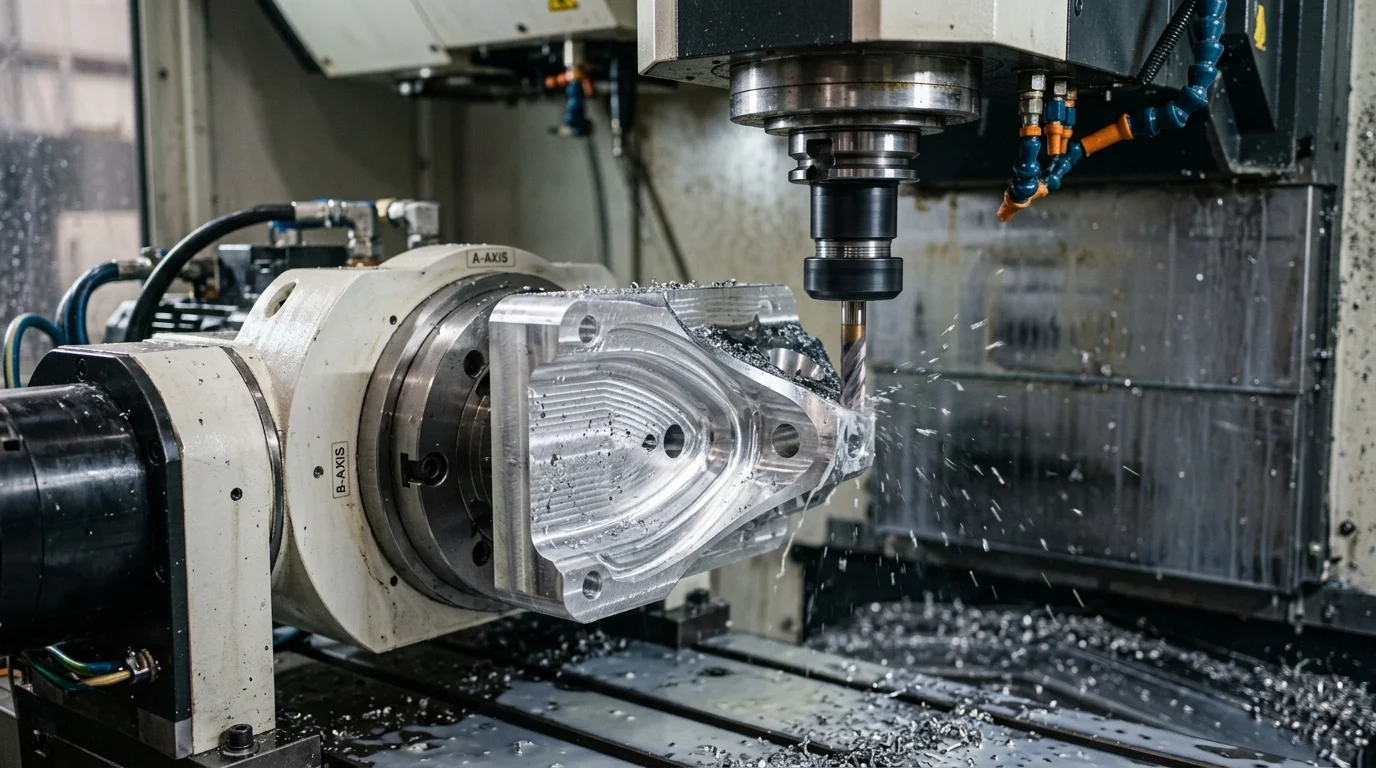
Procuring a 5-axis system in 2026 involves navigating a wide spectrum of pricing tiers. Market segmentation has matured, offering distinct categories based on rigidity, speed, and volumetric accuracy.
Knowing where a factory’s production needs fall on this spectrum prevents over-purchasing capabilities that will never be utilized, or under-purchasing rigidity that results in scrapped parts.
Entry-Level, Mid-Range, and High-Precision Price Ranges
Entry-level 3+2 positional machines, often built on modified 3-axis frames with trunnion tables, typically range from $60,000 to $120,000. These are suitable for smaller aluminum parts and basic multi-sided machining.
Mid-range systems, designed for simultaneous 5-axis contouring with better thermal stability, sit between $150,000 and $350,000. High-precision, high-dynamic machines built for aerospace alloys and complex mold-making frequently exceed $400,000, driven by advanced kinematics and superior dampening characteristics.
Hidden Costs Beyond the Base Price
Buyers often underestimate the auxiliary expenses required to operationalize a new machine. High-end CAM software capable of generating safe, collision-free 5-axis toolpaths generally costs between $5,000 and $15,000 per seat.
Additionally, custom post-processors can add $2,000 to $5,000. Initial tooling packages, shrink-fit tool holders, and specialized workholding solutions like zero-point clamping systems routinely add $10,000 to $25,000 to the initial deployment cost.
Price Comparison by Machine Class
Understanding the capabilities within each price band helps small factories align their budget with actual production needs. The table below outlines the general market expectations for different machine classes in 2026.
| Machine Class | Price Range (USD) | Typical Spindle Speed | Volumetric Accuracy | Target Materials |
|---|---|---|---|---|
| Entry-Level | $60k – $120k | 10,000 – 12,000 RPM | ±0.0005 in | Aluminum, Plastics |
| Mid-Range | $150k – $350k | 12,000 – 18,000 RPM | ±0.0002 in | Steel, Stainless, Brass |
| High-Precision | $400k+ | 20,000 – 30,000+ RPM | < ±0.0001 in | Titanium, Inconel, Hardened Tool Steel |
Technical Specifications That Drive Cost
The hardware and software architecture of a machine tool dictates both its performance and its price. Small factories must carefully evaluate which specifications are mandatory for their specific product mix and which are unnecessary luxuries.
Axis Configuration, Control System, and Spindle Performance
The physical layout of the machine—whether a trunnion-style table, a swivel head, or an articulating spindle—impacts rigidity and cost. Trunnion designs are generally more cost-effective for small parts, while articulating heads are necessary for heavy, oversized workpieces.
Control systems from tier-one providers like Heidenhain, Siemens, or Fanuc command premium prices but offer superior processing speeds for complex surface finishes. Upgrading from a standard 12,000 RPM spindle to a 24,000 RPM high-speed, high-torque spindle can easily add $15,000 to $25,000 to the base price.
Material, Part Complexity, and Tolerance Requirements
Machining hard superalloys requires heavy cast-iron or polymer concrete bases to dampen vibrations, significantly increasing manufacturing and shipping costs.
If a factory’s parts require tight tolerances of ±0.0001 inches, the machine will need active thermal compensation and linear glass scales on all axes. Adding linear scales for absolute positioning accuracy typically increases the machine’s cost by $20,000 to $30,000, but it is a non-negotiable requirement for aerospace or medical component manufacturing.
Quality, Maintenance, and Training Trade-Offs
Higher initial build quality generally yields a higher Mean Time Between Failures (MTBF). However, complex 5-axis kinematics require stringent preventative maintenance. Factory managers should budget $3,000 to $8,000 annually for OEM maintenance contracts.
Furthermore, training operators to handle simultaneous 5-axis machining is intensive. Investing in crash-avoidance software and simulation training reduces the risk of catastrophic spindle collisions, which can cost upwards of $20,000 to repair, making upfront training a highly cost-effective trade-off.
How to Compare Suppliers and Delivery Risk
Supplier selection carries as much weight as the machine’s technical specifications. Supply chain volatility in 2026 means that evaluating a vendor’s reliability, support infrastructure, and logistical competence is vital to minimizing operational risk.
OEMs, Local Dealers, and Import Options
Purchasing directly from an Original Equipment Manufacturer (OEM) often ensures access to high-level engineering support, while buying through a local dealer provides faster on-site service. Import options from emerging markets offer attractive price points, sometimes 30% below established US or European brands.
However, overseas imports can carry delivery lead times ranging from 12 to 24 weeks, whereas localized inventory might be delivered in 4 to 6 weeks. Small factories must weigh the capital savings of an import against the opportunity cost of delayed production.
Compliance, Certification, and Software Licensing
Industrial equipment must meet regional safety and electrical standards, such as CE marks in Europe or UL/CSA certifications in North America. Non-compliant imported machinery can lead to severe fines or insurance invalidation.
Additionally, software licensing models have shifted; many control features and monitoring applications now operate on subscription models. Annual software maintenance and licensing fees can amount to 10% to 15% of the original software cost, which must be factored into operating budgets.
Logistics, Installation, and Site Readiness
Transporting a 15,000-pound precision instrument requires specialized logistics. Standard factory floors may not support the dynamic loads of a high-speed 5-axis mill.
Preparing a site often requires pouring a specialized 6 to 12-inch reinforced concrete isolation pad, which can cost between $5,000 and $15,000. Professional rigging and installation services, necessary to ensure the machine remains geometrically trammed during placement, typically add another $3,000 to $10,000 depending on facility access and geographic location.
How to Decide if the Investment Is Worth It
Justifying the capital expenditure for advanced machining centers requires rigorous financial modeling. Small factories must transition from viewing the purchase as a sunk cost to evaluating it as an engine for capacity expansion and margin improvement.
ROI Models for Small Factories
Return on Investment (ROI) calculations for a 5-axis machine must account for reduced setup times, lower scrap rates, and the ability to win complex bids. A well-utilized 5-axis center in a high-mix environment often achieves a payback period of 18 to 36 months.
The table below illustrates a simplified comparative ROI model for a standard complex part requiring multiple operations.
| Metric | Traditional 3-Axis | 5-Axis Machining |
|---|---|---|
| Setups Required | 4 | 1 |
| Total Setup Time | 120 minutes | 30 minutes |
| Fixture Costs | $2,500 (multiple) | $800 (single) |
| Labor Cost per Part (at $50/hr) | $100.00 | $25.00 |
| Annual Yield Capacity | 2,500 units | 6,000+ units |
A Practical Buying and Shortlisting Process
A practical shortlisting process begins with defining the maximum workpiece envelope and the toughest material to be cut. Factories should issue Requests for Quotation (RFQs) to at least three vendors, demanding turnkey proposals that include rigging, installation, post-processors, and initial training.
Before final sign-off, buyers should mandate a test cut of their most complex part to verify surface finish and accuracy. Achieving a Process Capability Index (Cpk) greater than 1.33 during the test cut provides concrete assurance that the machine will deliver reliable quality once integrated into the production line.
Key Takeaways
- The most important conclusions and rationale for 5-Axis CNC Machine
- Specs, compliance, and risk checks worth validating before you commit
- Practical next steps and caveats readers can apply immediately
Frequently Asked Questions
How much does a 5-axis CNC machine cost in 2026 for a small factory?
Typical 2026 pricing is $60,000–$120,000 for entry-level 3+2, $150,000–$350,000 for simultaneous 5-axis, and $400,000+ for high-precision aerospace-grade machines.
What extra costs should I budget beyond the machine price?
Plan for CAM software ($5,000–$15,000), post-processors ($2,000–$5,000), tooling and holders, workholding, installation, training, coolant, and maintenance. These can add $10,000–$25,000+ upfront.
Which 5-axis machine type is best for small factories?
For small to mid-size parts, a trunnion-style 5-axis machine is often the most cost-effective. It suits multi-sided machining, compact layouts, and faster setup reduction.
Can a 5-axis CNC machine deliver fast ROI for smaller manufacturers?
Yes, if you run complex, high-mix parts. Done-in-one machining can cut setup time by up to 60%, reduce labor hours, and improve lead times, supporting quicker payback.
How can OTURN Machinery help select the right 5-axis machine?
OTURN can match your parts, materials, and budget to suitable 5-axis machining centers from its Chinese group factories, with support on configuration, supplier access, and overseas service.
Post time: Apr-23-2026