


Why High Precision Machining Matters for Industrial Buyers
In industrial manufacturing, the definition of “acceptable tolerance” has drastically narrowed. High precision machining now routinely dictates dimensional accuracies ranging from ±0.001 mm to ±0.005 mm. For B2B procurement professionals, sourcing components at this micron level is no longer an engineering luxury but a strict operational baseline.
Sourcing these highly accurate parts requires an intricate understanding of how tight tolerances influence total cost of ownership, assembly line efficiency, and end-product reliability. When tolerances tighten, the margin for error in supply chain execution approaches zero.
Impact on part performance and tolerances
The mathematical correlation between part tolerance and mechanical performance is absolute. When components are machined with micron-level accuracy, the friction coefficients in mating parts drop significantly, reducing thermal degradation and mechanical wear. In fluid dynamics applications, such as high-pressure hydraulic valves, holding a geometric tolerance of 2 microns prevents micro-leaks that could otherwise lead to catastrophic system failures.
Furthermore, precision machining minimizes assembly variations, effectively eliminating the need for manual shimming or hand-fitting on the production line. This precision-driven interchangeability can accelerate throughput by up to 25% and extend the Mean Time Between Failures (MTBF) of the final mechanical assembly by 30% to 40%.
Industries that require micron-level accuracy
While many sectors benefit from advanced CNC machining, certain industries are structurally dependent on micron-level accuracy to meet regulatory and safety standards. Aerospace manufacturers require turbine blades and structural components capable of withstanding extreme thermal and kinetic stress without deformation. The medical device sector demands flawless surface finishes and exact dimensions for orthopedic implants and surgical robotics.
Similarly, the automotive industry relies heavily on precision turning centers for crankshafts, wheel hubs, and fuel injection systems to ensure maximum drivetrain efficiency and emissions compliance.
| Industry | Typical Component | Tolerance Requirement | Common Material |
|---|---|---|---|
| Aerospace | Turbine Blades, Actuators | ±0.002 mm to ±0.005 mm | Titanium, Inconel |
| Medical | Implants, Surgical Instruments | ±0.001 mm to ±0.003 mm | 316L Stainless, Cobalt Chrome |
| Automotive | Crankshafts, Fuel Injectors | ±0.005 mm to ±0.010 mm | Forged Steel, Aluminum Alloys |
| Energy | Valve Housings, Rotors | ±0.005 mm to ±0.015 mm | Duplex Stainless Steel |
Machine, Process, and Metrology Factors
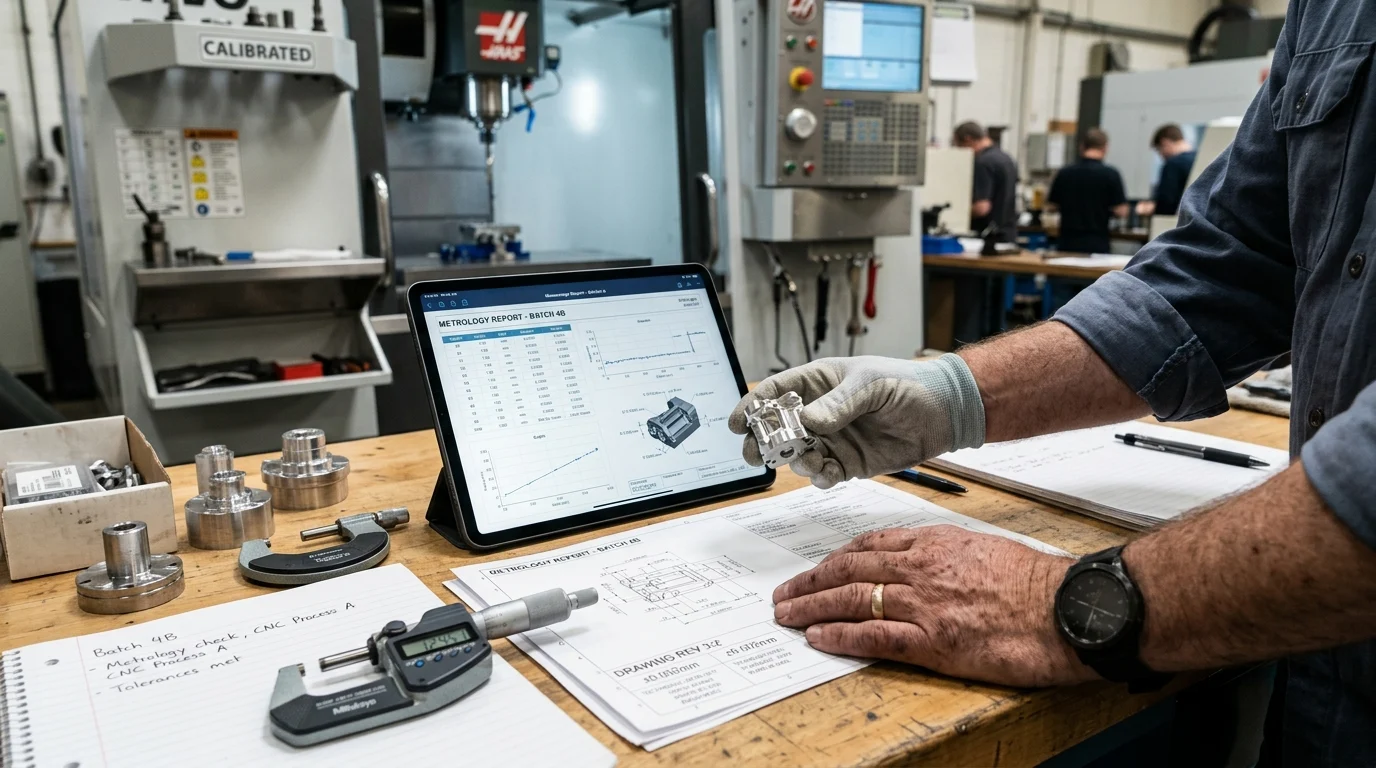
Achieving continuous micron-level accuracy requires a sophisticated ecosystem of advanced machinery, optimized cutting processes, and rigorous metrology. Industrial buyers must look beyond basic machine specifications and evaluate the underlying architecture of a supplier’s equipment.
High-quality CNC machine tools are defined by their high rigidity, superior vibration absorption, and compact layouts. These foundational elements are critical for stabilizing the cutting environment during heavy material removal or high-speed finishing operations.
CNC machine configurations for precision machining
The configuration of the CNC machine directly dictates the achievable geometric tolerance. While 3-axis vertical machining centers are suitable for simpler geometries, complex components often require 5-axis machining centers or specialized gantry drilling machines. By utilizing 5-axis technology, manufacturers can machine a part on multiple sides in a single setup.
Reducing the number of setups from three to one eliminates stack-up errors, improving overall positional accuracy by up to 60%. Furthermore, horizontal machining centers equipped with automatic pallet changers allow for continuous production without sacrificing the strict alignment required for precision flywheel, valve, or mold manufacturing.
Thermal stability, spindle performance, and guideway design
Environmental and mechanical thermodynamics play a massive role in high precision machining. Spindle performance is paramount; spindles operating between 12,000 and 24,000 RPM must maintain a runout of less than 2 microns to prevent tool deflection and chatter. However, high speeds generate heat, causing thermal expansion in the machine casting.
Premium suppliers utilize active thermal compensation systems, circulating chilled coolant through the spindle and ball screws to maintain temperatures within a strict ±0.5°C window. Additionally, the choice between linear guideways for high-speed motion and box guideways for heavy-duty cutting rigidity determines how well the machine absorbs vibration during aggressive material removal.
How to evaluate repeatability and accuracy
Evaluating a supplier’s technical capability requires differentiating between resolution, repeatability, and accuracy. Procurement teams should request machine calibration records based on internationally recognized standards like ISO 230-2.
A top-tier machining center should demonstrate a positioning accuracy of ±0.003 mm and a repeatability of ±0.002 mm across its full travel stroke. Suppliers committed to high precision frequently employ laser interferometers and ballbar testing to calibrate their machine axes, ensuring that volumetric accuracy remains consistent even after thousands of operating hours.
How Procurement Teams Should Source Precision Machining Suppliers
Identifying and contracting a high precision machining partner is fundamentally different from sourcing commodity hardware. Procurement teams must navigate a complex matrix of technical capabilities, quality management systems, and supply chain logistics.
A strategic approach ensures that the chosen supplier acts as a reliable extension of the buyer’s own manufacturing ecosystem, capable of delivering consistent quality while managing lower equipment investment costs and accelerating Return on Investment (ROI).
Supplier qualification criteria
The qualification process must begin with rigorous quality system audits. Certifications such as ISO 9001:2015 are mandatory baselines, but sector-specific certifications like AS9100 for aerospace or ISO 13485 for medical devices indicate a mature quality culture.
Beyond paperwork, buyers should evaluate the average age and maintenance schedule of the supplier’s machine park. CNC machines older than 5 to 7 years frequently struggle to hold tolerances tighter than 5 microns without extensive mechanical rebuilds. Therefore, partnering with suppliers who maintain a modern fleet of turning centers and machining centers is a critical risk mitigation strategy.
MOQ, lead time, customization, and acceptance standards
Procurement dynamics in high precision machining often feature inverse relationships between volume and lead time. Because of the extensive programming, custom fixturing, and metrology setup required, Minimum Order Quantities (MOQs) for highly complex parts may range from 50 to 500 units, while initial lead times can stretch from 8 to 12 weeks.
Buyers must negotiate clear acceptance standards upfront, establishing Process Capability Index (Cpk) targets. A Cpk requirement of greater than 1.33 (or 1.67 for safety-critical components) ensures that the supplier’s manufacturing process is statistically stable and capable of producing parts within the specified tolerance band with minimal defects.
Comparing suppliers by machine portfolio and capability
A comprehensive supplier evaluation must compare the depth and breadth of their machine portfolio. Relying on a vendor with a limited range of equipment often leads to production bottlenecks or subcontracting risks. Ideal partners offer a rich configuration of vertical, horizontal, double-column, and 5-axis machining centers, alongside special purpose machines for specific metalworking solutions.
| Sourcing Tier | Capability Profile | Typical Tolerance | Ideal Application Profile |
|---|---|---|---|
| Tier 1 (Strategic Partner) | 5-Axis, CMM Lab, Thermal Control | < ±0.003 mm | Aerospace, Complex Medical Implants |
| Tier 2 (Advanced Job Shop) | 3/4-Axis CNC, Basic Metrology | ±0.010 mm to ±0.025 mm | Automotive Aftermarket, Industrial Valves |
| Tier 3 (Commodity Machining) | Standard CNC Lathes/Mills | > ±0.050 mm | General Hardware, Brackets, Enclosures |
Quality Assurance, Compliance, Packaging, and Logistics Controls
The effort expended to achieve micron-level accuracy on the CNC machine is entirely wasted if the part is compromised during inspection, handling, or transit.
Robust quality assurance protocols, strict compliance documentation, and specialized export packaging are non-negotiable elements of the high precision supply chain, ensuring that the tolerances achieved on the factory floor survive global logistics.
Inspection plans and measurement reports
High precision machining demands equally precise measurement techniques. Suppliers must utilize Coordinate Measuring Machines (CMM) with sub-micron volumetric accuracy to validate complex geometries. Procurement teams should mandate a comprehensive First Article Inspection (FAI) report, such as the AS9102 format used in aerospace, before approving full production.
For ongoing production batches, inspection plans must be statistically sound. Depending on the criticality of the part, inspection frequencies may range from a 100% check of critical dimensions to an Acceptable Quality Limit (AQL) of 0.65 for less sensitive features, ensuring that any deviation is caught before the batch is shipped.
Export packaging and part protection
Micron-level surface finishes and razor-thin edges are highly susceptible to oxidation and mechanical shock. Standard bulk packaging is entirely inadequate. Export packaging for precision machined parts must incorporate Volatile Corrosion Inhibitor (VCI) bags or specialized anti-rust oils to prevent oxidation during maritime transit.
Furthermore, parts should be isolated using custom thermoformed plastic trays or high-density foam inserts to prevent micro-collisions. In extreme cases, such as ultra-precision optical mounts, logistics contracts may even require temperature-controlled shipping containers to maintain transit temperatures between 15°C and 25°C, preventing thermal expansion or contraction stress.
Compliance and documentation requirements
Global trade in precision components requires exhaustive documentation to satisfy both customs authorities and industry regulators. Material Test Reports (MTRs) are mandatory to verify the chemical composition and mechanical properties of the raw alloys before machining begins.
Depending on the destination market, compliance with directives such as RoHS (Restriction of Hazardous Substances) and REACH is required for electronics and consumer-facing assemblies. Furthermore, complete lot traceability—tracking the component from the raw material heat lot through the specific CNC machine and operator—is essential for isolating potential defects and managing liability in high-stakes industries.
Decision Framework for Selecting a High Precision Machining Partner

Selecting the right manufacturing partner or direct factory is a pivotal decision that impacts long-term operational stability. Procurement directors need a structured decision framework that moves beyond basic unit price comparisons, focusing instead on total value, risk mitigation, and continuous technical support.
Step-by-step supplier evaluation process
An effective supplier evaluation follows a rigorous, step-by-step methodology. Phase one involves a Non-Disclosure Agreement (NDA) followed by a technical drawing review to assess the supplier’s Design for Manufacturability (DFM) feedback.
Phase two is the capability matrix matching, ensuring the vendor possesses the specific gantry drilling machines or turning centers required. Phase three demands a paid sample run—typically 10 to 20 pieces—to empirically verify the supplier’s Cpk and surface finish claims. Finally, phase four is an on-site or virtual facility audit, with a heavy focus on their temperature control infrastructure, tool management systems, and the calibration status of their metrology lab.
Balancing price, precision, capacity, and maintenance support
The ultimate goal of the procurement framework is to balance price, precision, capacity, and lifecycle support. Chasing the absolute lowest unit cost is a false economy in high precision machining; a 15% reduction in purchase price is instantly negated if the defect rate exceeds 2%, leading to costly assembly line stoppages or catastrophic field failures.
Buyers must evaluate the Total Cost of Ownership (TCO). Partnering with an integrated solution provider—one that offers complete support from initial sourcing to ongoing logistics—ensures that maintenance, tooling optimization, and capacity scaling are managed proactively. This holistic approach guarantees that the supply chain remains resilient, efficient, and capable of holding micron-level tolerances year after year.
Key Takeaways
- Wholesale sourcing and supply-chain implications for high precision machining
- Specifications, compliance, and commercial terms buyers should validate
- Actionable recommendations for distributors and procurement teams
Frequently Asked Questions
What machine features matter most for micron-level accuracy?
Prioritize high rigidity, vibration absorption, thermal stability, and low spindle runout. On OTURN machinery, these features help maintain repeatable accuracy during high-speed finishing and heavy-duty cutting.
When should I choose a 5-axis machining center for precision parts?
Choose 5-axis when parts need multiple faces, complex angles, or fewer setups. One-setup machining reduces stack-up error and is ideal for aerospace, medical, mold, and complex automotive components.
How do I evaluate CNC accuracy beyond the brochure specs?
Ask for repeatability, positioning accuracy, spindle runout, thermal compensation details, and inspection reports. Also confirm how the supplier controls shop temperature and verifies parts during production.
Which industries benefit most from high precision machining?
Aerospace, medical, automotive, and energy benefit most. Typical parts include turbine components, implants, crankshafts, wheel hubs, valves, and rotors where tight tolerances improve performance and reliability.
Can OTURN help with precision machines for specific parts like valves or crankshafts?
Yes. OTURN offers CNC lathes, turning centers, machining centers, 5-axis machines, and special-purpose solutions for valves, flywheels, wheel hubs, crankshafts, molds, aerospace, and medical parts.
Post time: Apr-17-2026