


Introduction
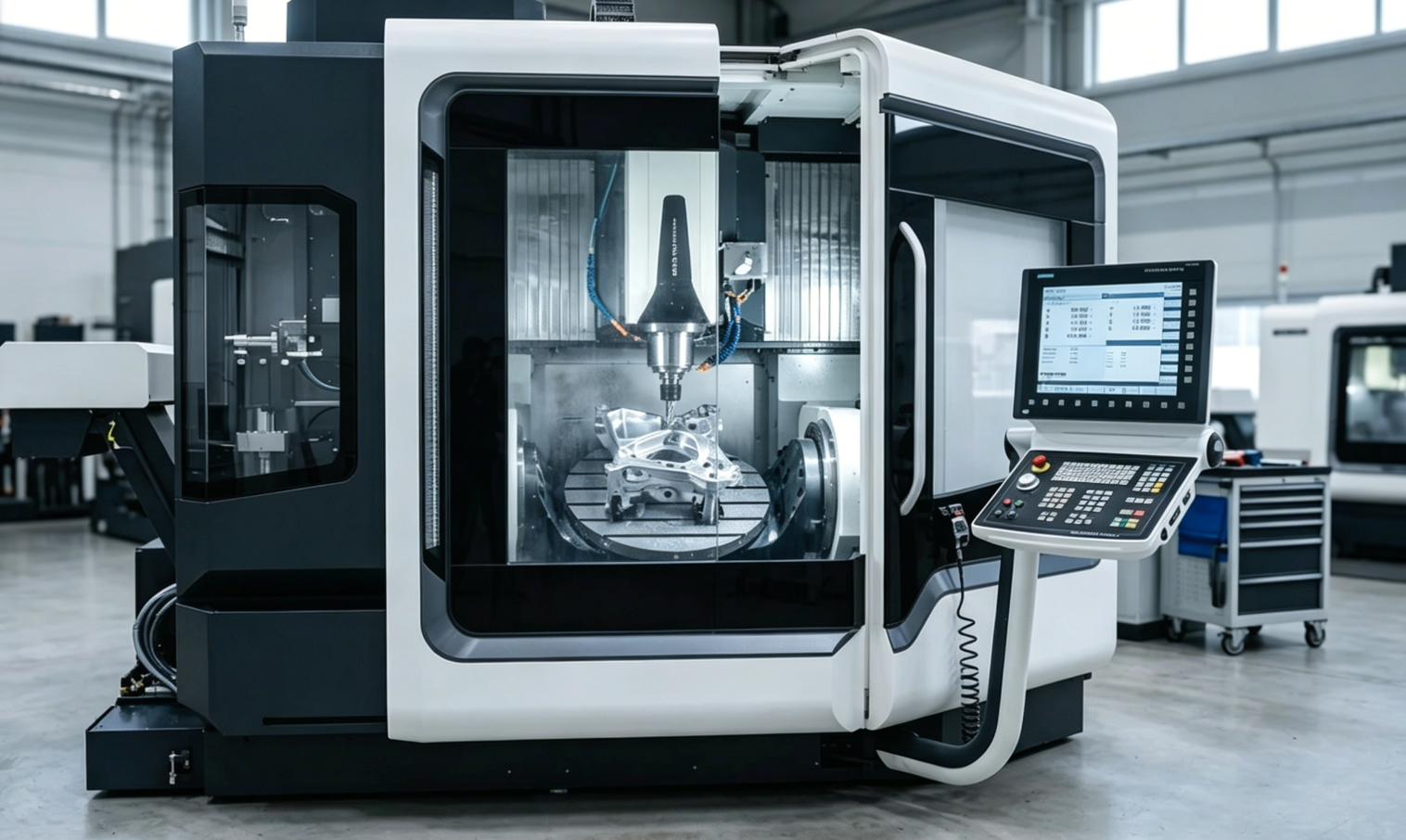
Selecting a 5-axis machining center for titanium aerospace work requires more than comparing axis travel or spindle speed. Titanium alloys demand rigid machine structures, stable thermal control, precise kinematics, and cutting performance that can handle heat, vibration, and complex geometries without sacrificing accuracy. This article explains the key criteria that separate a capable machine from a costly compromise, with attention to aerospace tolerances, setup reduction, tool life, and production efficiency. By the end, readers will have a practical framework for evaluating which 5-axis machining center is best suited for high-value titanium alloy components and why that choice directly affects quality, throughput, and manufacturing cost.
Why a 5-Axis Machining Center Is a Strategic Investment
The aerospace industry relies heavily on titanium alloys, particularly Ti-6Al-4V, for components that demand an exceptional strength-to-weight ratio and high corrosion resistance. However, the inherent properties of titanium, such as its low thermal conductivity and tendency to work-harden, make it notoriously difficult to machine. Transitioning to a 5-axis machining center is no longer merely an upgrade for aerospace manufacturers; it is a fundamental strategic requirement to remain competitive.
By allowing a cutting tool to approach a workpiece from virtually any angle, 5-axis technology eliminates the need for multiple manual setups. This capability dramatically reduces fixture costs, mitigates the risk of tolerance stacking errors, and accelerates overall production cycles. For facilities processing high-value titanium forgings, the integration of 5-axis simultaneous milling directly correlates to maximized yield and optimized resource allocation.
Aerospace production economics for titanium machining
Machining titanium poses severe economic challenges. Traditional 3-axis operations often require five to six distinct setups to complete complex aerospace parts, introducing idle time and increasing the probability of scrap. A 5-axis machining center consolidates these operations down to one or two setups, commonly referred to as “Done-in-One” machining.
This consolidation has a profound impact on material removal rates (MRR) and tool life. Because 5-axis kinematics allow the spindle to maintain an optimal orientation relative to the workpiece, operators can utilize shorter, more rigid cutting tools. This reduces harmonic vibration and tool deflection, permitting feed rates to increase by 20% to 30% compared to extended-reach tools on 3-axis machines. Given that aerospace titanium components frequently exhibit a buy-to-fly ratio exceeding 10:1—meaning 90% of the expensive raw forging is milled away into chips—optimizing MRR while preserving tool life is the primary driver of production economics.
Titanium components that justify 5-axis capability
Specific aerospace geometries dictate the absolute necessity of simultaneous 5-axis interpolation. Jet engine impellers, blisks (bladed disks), and turbine blades feature highly contoured, twisting aerodynamic surfaces that cannot be accessed or machined efficiently with fixed-axis equipment. 5-axis centers allow the tool path to seamlessly follow these complex curvatures without stopping to reposition.
Beyond rotating engine components, large structural parts such as titanium bulkheads, landing gear beams, and wing pylons also justify 5-axis capability. These components often feature deep pockets, undercut profiles, and angled intersecting holes. Utilizing 5-axis positioning (3+2 machining) enables the use of standard tooling to machine these deep cavities at aggressive parameters, ensuring structural integrity while meeting the strict weight-reduction mandates of modern commercial and military aircraft.
Technical Criteria for Choosing the Best 5-Axis Machining Center
Identifying the best 5-axis machining center requires moving beyond standard catalog specifications. Titanium’s high shear strength and poor heat dissipation demand machine architectures that prioritize immense structural rigidity, high-torque power delivery, and superior thermal management. Selecting the wrong machine configuration can lead to catastrophic tool failure, severe chatter, and scrapped high-value forgings.
Key machine specifications for titanium alloy machining
Titanium machining is fundamentally a high-torque, low-RPM application. The ideal 5-axis spindle for aerospace titanium should deliver a minimum of 300 Nm of continuous torque, with heavy-duty roughing applications often requiring geared spindles or high-torque motor spindles exceeding 1,000 Nm. Tool interfaces must be exceptionally rigid; HSK-A100 or CAT50 tapers with dual-contact faces are standard requirements to handle the massive radial loads generated during titanium roughing.
Coolant delivery is equally critical. Because titanium traps heat at the cutting edge, high-pressure through-spindle coolant (TSC) operating at a minimum of 70 bar (1,000 PSI) is necessary to blast chips away, prevent recutting, and lubricate the cutting zone. Furthermore, the machine’s linear axes must feature heavily ribbed cast iron or polymer concrete beds to dampen low-frequency vibrations, ensuring stable cuts even when pushing heavy chip loads.
Comparing trunnion, swivel-head, and gantry designs
Machine architecture dictates both part capacity and dynamic stiffness. Trunnion-style 5-axis machines, where the A and C rotary axes are integrated into a tilting table, offer exceptional rigidity and are generally considered the best choice for compact to medium-sized titanium components (up to 1,000 mm in diameter). The trunnion design provides excellent support directly under the cutting zone.
Swivel-head (or articulating head) machines place the rotary axes on the spindle itself, leaving the table stationary. This configuration is advantageous for heavy, asymmetric parts that would exceed the weight capacity of a trunnion table. Gantry-style 5-axis centers represent the ultimate solution for massive structural aerospace components, often featuring X-axis travels exceeding 3 to 5 meters. By moving the bridge rather than the heavy workpiece, gantry machines maintain consistent dynamic performance regardless of the part’s mass.
Evaluation criteria and comparison tables
A rigorous evaluation requires comparing these architectures against specific operational metrics. Procurement teams must weigh the maximum payload, dynamic stiffness, and floor space requirements against their projected part mix.
| Architecture Type | Ideal Part Size (Max Dimension) | Max Payload Capacity | Rigidity for Titanium Roughing | Typical Application |
|---|---|---|---|---|
| Trunnion Table | Up to 1,000 mm | 500 kg – 1,500 kg | Very High | Engine blisks, impellers, small brackets |
| Swivel-Head | 1,000 mm – 2,500 mm | 2,000 kg – 5,000 kg | High | Landing gear components, mid-size frames |
| Gantry / Bridge | 3,000+ mm | 5,000+ kg | Exceptional | Large structural bulkheads, wing ribs |
This matrix highlights that while trunnion designs offer the highest stiffness-to-size ratio for aggressive titanium roughing, large-scale aerospace structural manufacturing inevitably necessitates the expansive work envelopes of gantry systems.
Process Capability, Quality Assurance, and Compliance
Aerospace manufacturing is governed by stringent regulatory frameworks that leave zero margin for error. A 5-axis machining center must do more than cut metal; it must function as an integrated node within a closed-loop quality assurance system. Advanced process capabilities and onboard inspection technologies are essential to guarantee compliance and part traceability.
Process control features for titanium aerospace parts
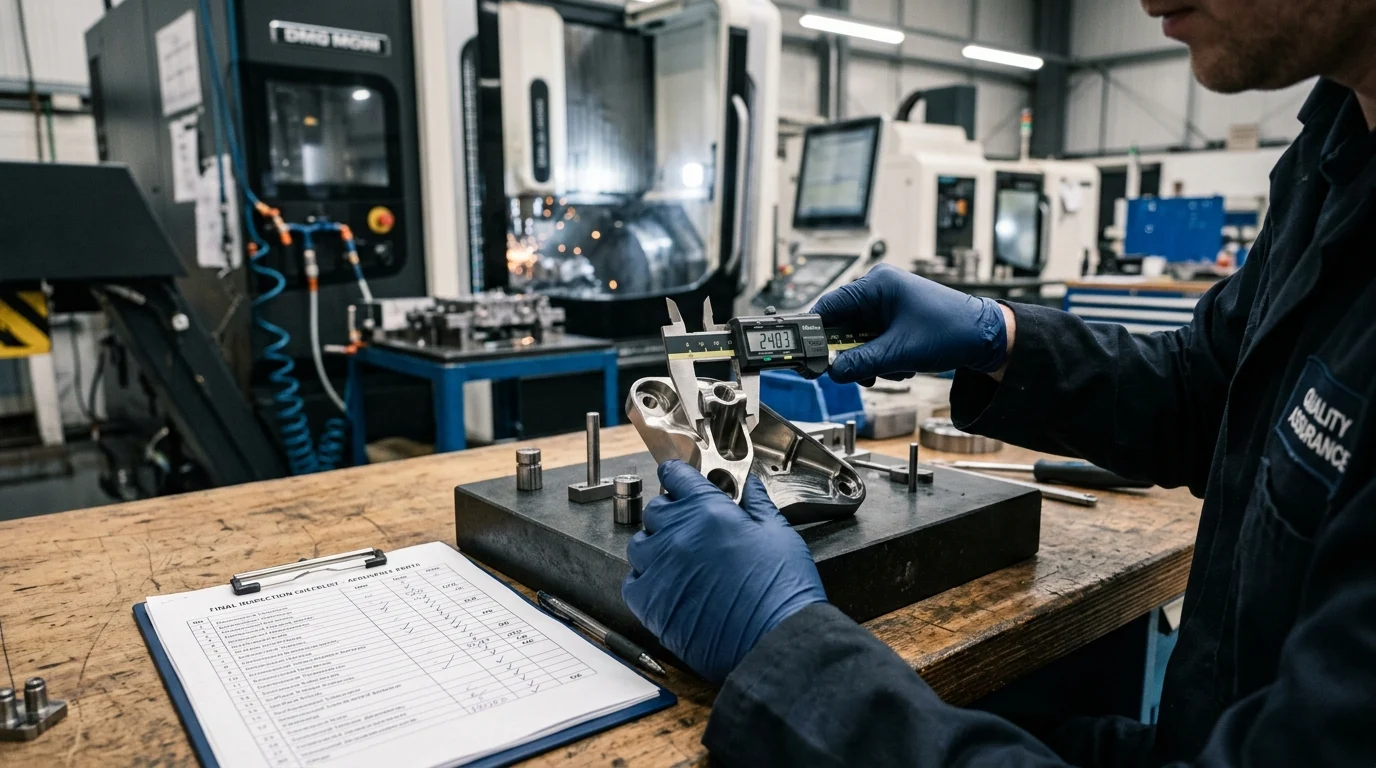
Advanced process control is non-negotiable when machining titanium, as tool wear is rapid and unpredictable. The best 5-axis centers incorporate in-machine tactile probing systems and non-contact laser tool setters. These systems automatically verify tool geometry before a cut and inspect critical part dimensions post-machining while the component is still fixtured.
Thermal drift is another major variable in long-cycle titanium machining. High-end machines utilize sophisticated thermal compensation algorithms, drawing data from dozens of temperature sensors embedded in the spindle, ballscrews, and machine castings. These systems dynamically adjust the machine’s kinematics to maintain volumetric accuracy within a tolerance band of less than 5 microns, even during uninterrupted 24-hour machining cycles.
AS9100-aligned quality and compliance requirements
Compliance with AS9100 and NADCAP standards requires rigorous documentation and process repeatability. Aerospace suppliers must prove that their manufacturing processes are statistically controlled. Modern 5-axis CNC controls facilitate this by logging high-frequency data—such as spindle load, servo motor current, and vibration signatures—for every single part produced.
To maintain compliance, the machine’s kinematic pivot points must be frequently calibrated. Features like RTCP (Rotary Tool Center Point) kinematics must be verified using automated calibration spheres and probes, ensuring that the machine maintains its required 5-axis volumetric accuracy over a standard 2,000-hour production interval between major preventive maintenance teardowns. This automated traceability directly supports AS9100 audit requirements.
How to Evaluate Suppliers, Implementation Risk, and Lifecycle Cost
Procuring a 5-axis machining center involves substantial capital outlay, but the initial purchase price is only a fraction of the Total Cost of Ownership (TCO). Evaluating machine tool builders requires a deep dive into their application engineering capabilities, regional support infrastructure, and the long-term cost drivers associated with titanium production.
Supplier selection factors and application support
Evaluating a machine tool supplier extends beyond the hardware. Aerospace manufacturers must prioritize OEMs that operate dedicated aerospace centers of excellence. These suppliers can assist in developing optimized post-processors, designing custom workholding, and establishing baseline cutting parameters for complex titanium alloys.
Service infrastructure is a critical risk mitigation factor. When a high-torque spindle crashes or fails due to the immense loads of titanium roughing, downtime costs can exceed thousands of dollars per hour. Procurement contracts should stipulate guaranteed response times, requiring localized spare parts availability and a spindle rebuild or replacement turnaround time of less than 48 hours.
Practical evaluation steps for procurement teams
Procurement teams must mandate rigorous runoff procedures before accepting a machine. A theoretical cycle time estimate is insufficient. Buyers should require a physical test cut on a representative titanium part, such as a localized bulkhead section.
During this runoff, the supplier must demonstrate not only the target cycle time but also statistical process control. A successful runoff should yield a Process Capability Index (Cpk) of greater than 1.33 on critical dimensions, proving that the machine can hold tight aerospace tolerances consistently under real-world cutting loads.
Lifecycle cost drivers including tooling and maintenance
Over a standard 10-year depreciation cycle, tooling and maintenance will often eclipse the initial capital expenditure, especially in titanium applications where carbide inserts degrade rapidly.
| Cost Category | Estimated % of 10-Year TCO | Primary Drivers in Titanium Machining |
|---|---|---|
| Capital Equipment | 35% | Base machine, automation, high-torque spindle upgrades |
| Consumable Tooling | 40% | Solid carbide endmills, indexable inserts, coolant |
| Maintenance & Service | 15% | Spindle rebuilds, ballscrew replacement, preventative care |
| Energy & Overhead | 10% | High-pressure coolant pumps, chiller units, power consumption |
Understanding this TCO breakdown forces procurement teams to value machine rigidity and vibration damping highly. A machine that is 20% more expensive upfront but extends tool life by 30% through superior stiffness will yield a significantly lower lifecycle cost over a decade of aerospace production.
Buying Priorities and Final Decision Framework
Finalizing the selection of a 5-axis machining center requires synthesizing technical specifications, quality mandates, and commercial realities into a cohesive procurement strategy. The ultimate goal is to deploy an asset that maximizes aerospace production economics while severely limiting supply chain risk.
Balancing throughput, precision, compliance, and cost
Striking the optimal balance between aggressive material removal and precise surface finishing is the core challenge. Machines optimized purely for high-speed aluminum machining will fail catastrophically when introduced to titanium. Conversely, overly massive machines may lack the dynamic agility required for high-feed simultaneous 5-axis finishing of aerodynamic surfaces.
Aerospace facilities should target an Overall Equipment Effectiveness (OEE) of at least 85%. Achieving this requires balancing the raw cutting capability of the machine with automation readiness. Integrating pallet pools or robotic machine tending can offset the slower cutting speeds dictated by titanium, allowing the 5-axis center to run unattended during lights-out shifts, thereby driving down the cost-per-part.
Final recommendation framework for aerospace manufacturers
A robust decision framework categorizes procurement based on part envelope and production volume. For structural components and engine parts under 1,000 mm, a heavy-duty trunnion 5-axis center equipped with an HSK-A100 spindle and >300 Nm of torque provides the best intersection of rigidity and footprint.
For structural beams and pylons exceeding 2,000 mm, a gantry-style machine with high-pressure coolant and integrated thermal compensation becomes the mandatory standard. By anchoring the decision framework in verifiable metrics—spindle torque, Cpk performance during runoff, and guaranteed service SLAs—aerospace manufacturers can confidently invest in 5-axis technology that will reliably machine titanium alloys for decades.
Key Takeaways
- The most important conclusions and rationale for Best 5-Axis Machining Center
- Specs, compliance, and risk checks worth validating before you commit
- Practical next steps and caveats readers can apply immediately
Frequently Asked Questions
Why is a 5-axis machining center better for titanium aerospace parts?
It cuts complex surfaces in one or two setups, reducing tolerance stack-up, fixture changes, and scrap risk on costly titanium forgings.
What spindle setup is best for machining Ti-6Al-4V?
Choose high torque over extreme RPM: at least 300 Nm continuous torque, with HSK-A100 or CAT50 tooling for rigid roughing and stable tool life.
How much coolant pressure is recommended for titanium machining?
Use through-spindle coolant at a minimum of 70 bar (1,000 PSI) to evacuate chips, control heat, and reduce edge wear.
Which 5-axis machine design suits titanium aerospace components best?
For compact to medium titanium parts, trunnion machines usually offer the best rigidity; larger structural parts often benefit from swivel-head or gantry layouts.
How does OTURN Machinery help buyers choose a 5-axis machining center?
OTURN matches part size, rigidity, and production goals with suitable 5-axis models, while supporting lower investment cost, faster ROI, and overseas service.
Post time: Apr-23-2026