


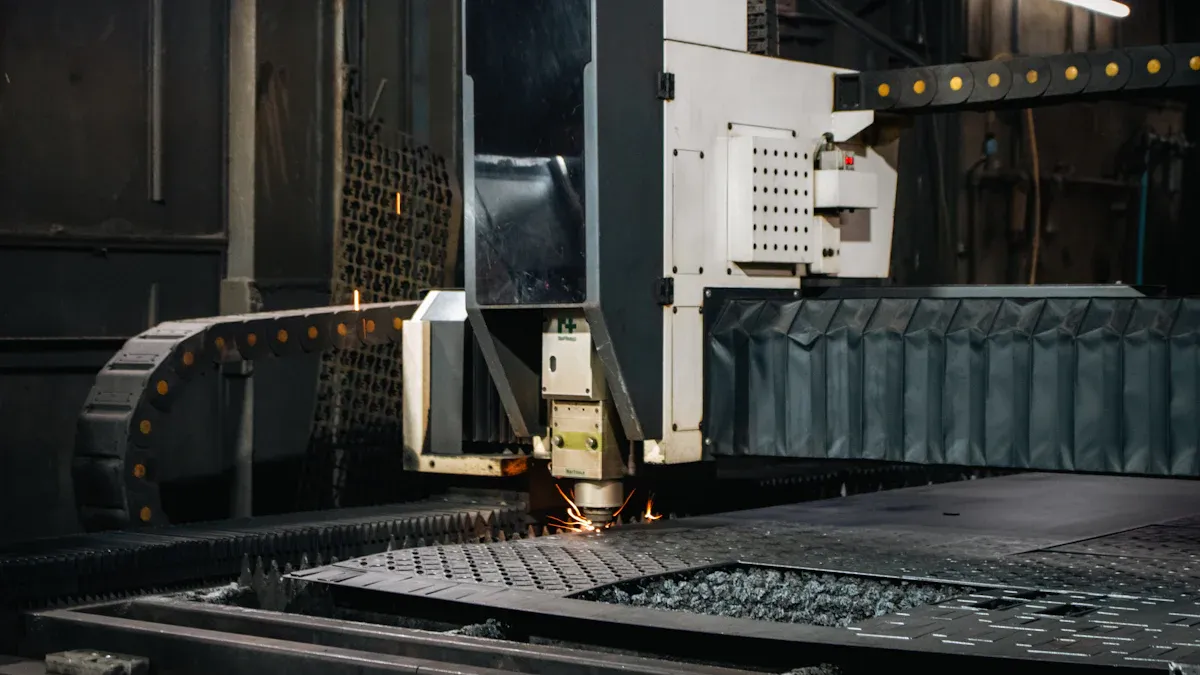
Choosing the right CNC machining center can significantly impact production efficiency. Manufacturers often face the question: which is better, vertical or horizontal CNC? Each type has unique features that cater to different needs. For instance, the CNC Vertical Machining Center excels in high precision CNC milling for smaller parts, while the CNC Horizontal Machining Center is ideal for horizontal CNC for large parts. Understanding these differences helps businesses optimize their operations and select the best option for their specific requirements.
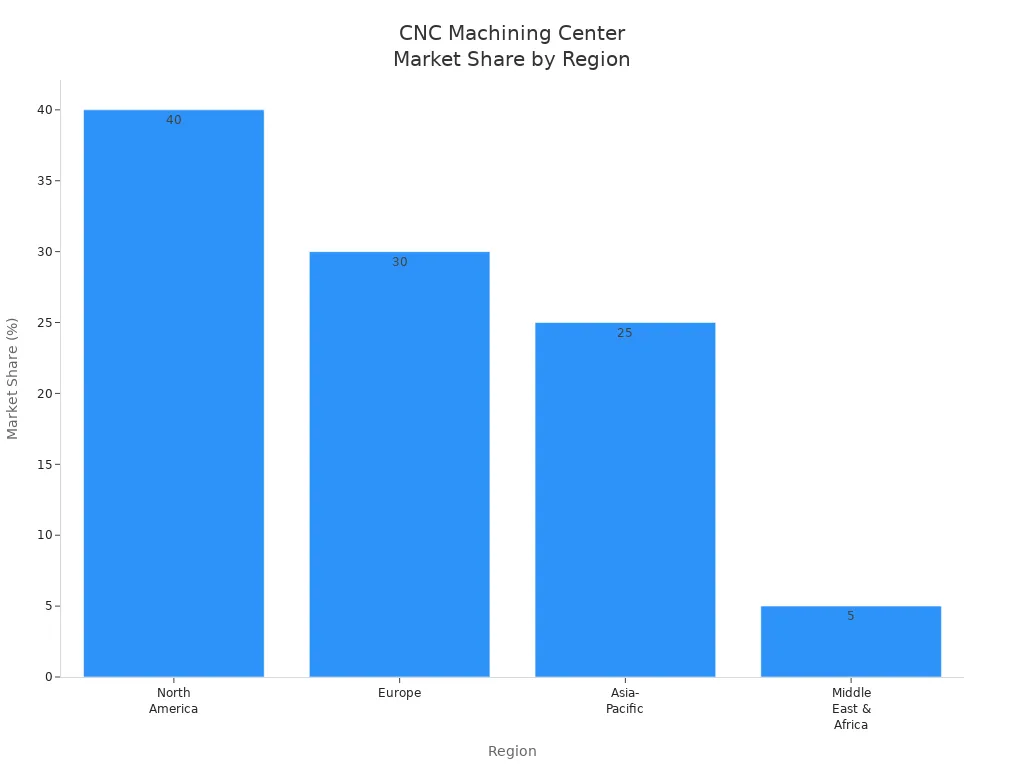
| Region | Market Share (%) |
|---|---|
| North America | 40 |
| Europe | 30 |
| Asia-Pacific | 25 |
| Middle East & Africa | 5 |
Key Takeaways
- CNC Vertical Machining Centers (VMCs) are ideal for high precision work on smaller parts, making them suitable for industries like automotive and medical devices.
- CNC Horizontal Machining Centers (HMCs) excel in handling larger components and complex geometries, offering multi-axis capabilities for high-volume production.
- Consider floor space when choosing between VMCs and HMCs; VMCs require less space, while HMCs need more room for efficient operation.
- Evaluate cost-effectiveness; VMCs have lower initial costs, but HMCs may provide better long-term ROI for high-volume production.
- Understand your production needs; VMCs are great for prototyping and short runs, while HMCs are better for continuous, high-volume manufacturing.
Understanding CNC Machining Centers
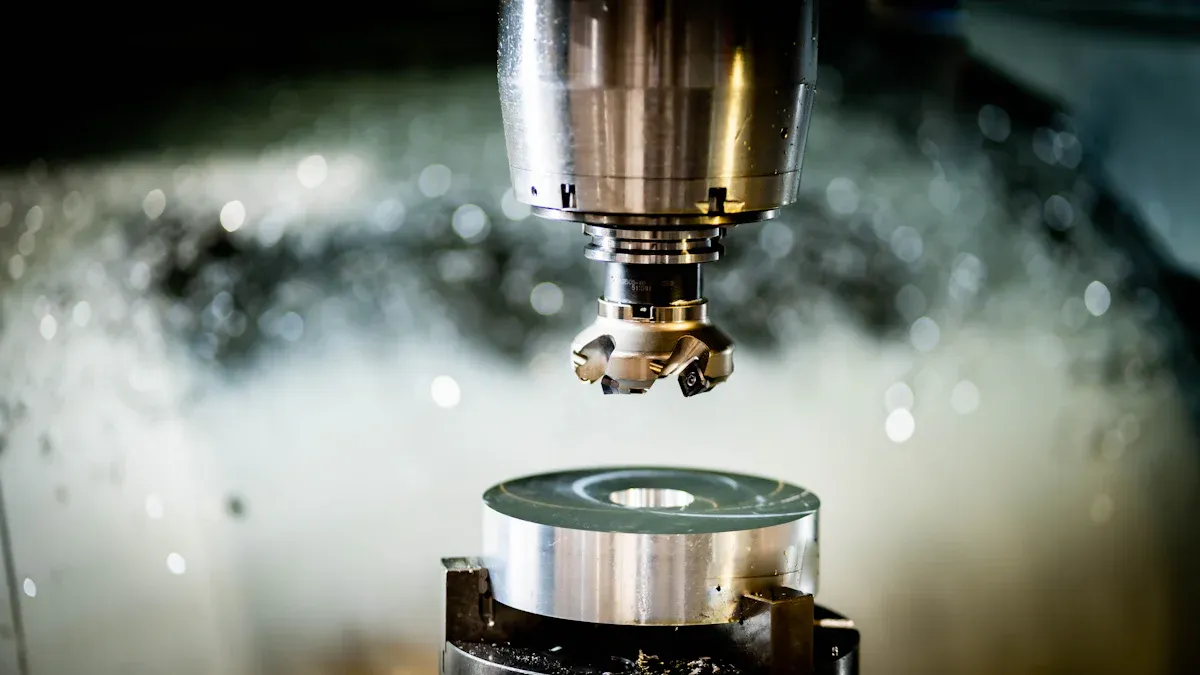
CNC machining centers are essential tools in modern manufacturing. They automate the machining process, allowing for high precision and efficiency. These centers consist of several key components that work together to produce intricate parts.
The primary components of CNC machining centers include:
| Component/Function | Description |
|---|---|
| Structure | Box-shaped structure made of high-strength HT300 cast iron, providing high rigidity and stability. |
| Capabilities | High speed, high precision, and rich configurations for efficiency and reliability. |
| Vibration Absorption | Reduces tool wear and improves workpiece quality. |
CNC machining centers can perform various operations, such as milling, drilling, and tapping. This versatility makes them suitable for a wide range of applications, from automotive to aerospace industries.
A CNC Vertical Machining Center, for example, is particularly effective for smaller parts that require high precision. Its vertical spindle orientation allows for easy access to the workpiece, enhancing visibility and control during the machining process.
In contrast, horizontal machining centers offer different advantages. They typically feature a high-rigidity structure with a 45° inclined integral bed design. This design supports multifunctional machining, making them ideal for larger components that demand robust processing capabilities.
Overall, understanding the components and functions of CNC machining centers helps manufacturers choose the right equipment for their specific needs. By selecting the appropriate center, businesses can optimize production efficiency and improve product quality.
Key Differences Between Vertical and Horizontal Machining Centers
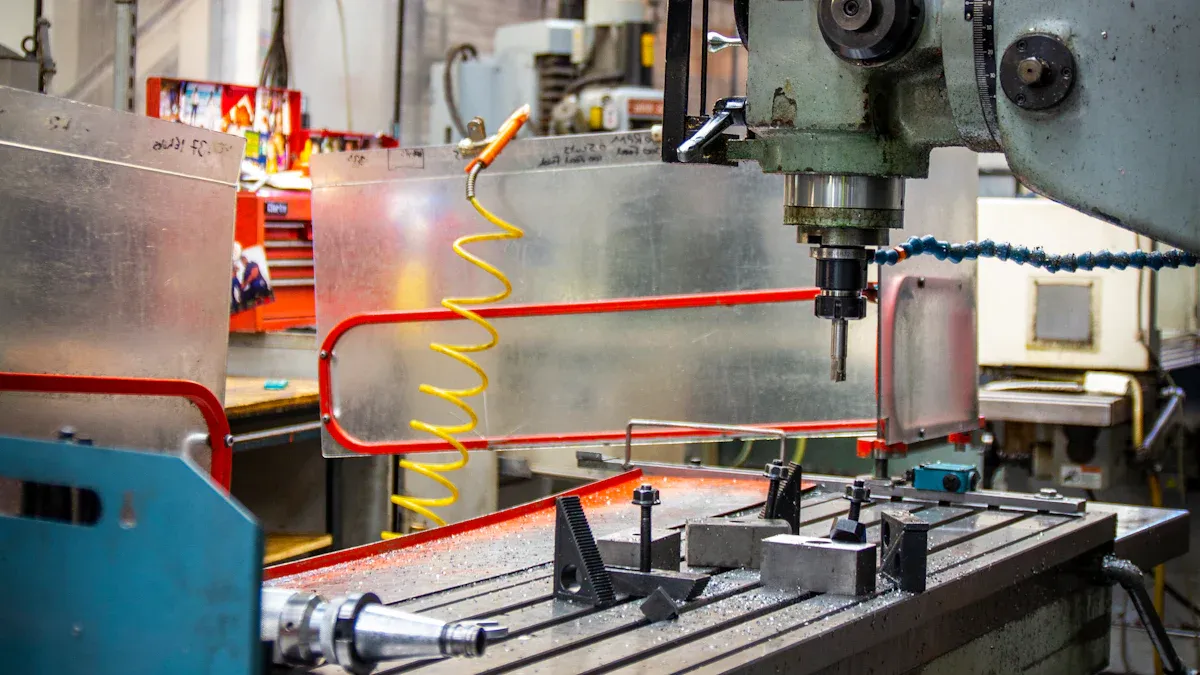
When comparing CNC vertical and horizontal machining centers, several key differences emerge that can influence a manufacturer’s choice. Understanding these distinctions helps businesses align their equipment with production needs.
- Spindle Orientation:
- Vertical Machining Centers (VMCs) feature a vertically oriented spindle. This design allows operators easy access to the workpiece from above, enhancing visibility during machining operations.
- Horizontal Machining Centers (HMCs) utilize a horizontally oriented spindle. This configuration enables machining from multiple angles without needing to reposition the workpiece, which is crucial for complex parts.
- Workpiece Handling:
- VMCs excel in handling smaller to medium-sized parts. Their design facilitates quick setup and monitoring, making them ideal for simpler geometries.
- HMCs are better suited for larger, heavier parts. They offer multi-sided machining capabilities, allowing manufacturers to complete complex operations in a single setup.
- Floor Space Requirements:
- VMCs generally require less floor space due to their vertical design. This compact footprint makes them suitable for shops with limited square footage.
- In contrast, HMCs demand a larger footprint because of their horizontal spindle configuration and integrated pallet changer systems. They necessitate ample space around the machine for efficient pallet loading and unloading.
- Tool Accessibility:
- VMCs provide excellent visibility and accessibility for operators. This feature simplifies setup and monitoring, making tool changes more straightforward.
- HMCs, while offering superior chip evacuation, may present more complex access for tool changes. Their design is optimized for high-volume production but can complicate maintenance.
| Feature | Vertical Machining Centers (VMCs) | Horizontal Machining Centers (HMCs) |
|---|---|---|
| Spindle Orientation | Vertically oriented | Horizontally oriented |
| Workpiece Handling | Easy access from above | Multi-sided machining capabilities |
| Ideal for | Smaller to medium-sized parts | Larger, heavier parts and complex operations |
Advantages of CNC Vertical Machining Centers
CNC Vertical Machining Centers (VMCs) offer several advantages that make them a popular choice in various manufacturing environments. Their design and functionality cater to specific needs, enhancing productivity and efficiency. Here are some key benefits of VMCs:
- Cost-Effectiveness:
VMCs generally have a lower purchase price compared to horizontal machining centers. This affordability makes them accessible for small to medium-sized businesses looking to invest in CNC technology. - Simplicity and Ease of Use:
The setup and operation of VMCs are intuitive. Operators can quickly learn to use these machines, leading to a shorter learning curve. This ease of use is particularly beneficial for new machinists entering the field. - Space Efficiency:
VMCs require less floor space due to their compact design. This feature is advantageous in crowded workshops where maximizing available space is crucial. - High Precision for Specific Jobs:
VMCs excel in machining heavy pieces on one face. Their vertical spindle orientation provides stability and precision, making them ideal for tasks that demand high accuracy. - Versatility:
VMCs can handle a variety of tasks, from simple drilling to complex 3D contouring. This versatility allows manufacturers to adapt to different production requirements without needing multiple machines.
The following table summarizes these advantages:
| Advantage | Description |
|---|---|
| Cost-Effectiveness | VMCs generally have a lower purchase price than horizontal machining centers, making them accessible. |
| Simplicity and Ease of Use | The setup and operation are intuitive, leading to a shorter learning curve for new machinists. |
| Space Efficiency | VMCs require less floor space due to their compact design, beneficial in crowded workshops. |
| High Precision for Specific Jobs | VMCs excel in machining heavy pieces on one face, providing stability and precision. |
| Versatility | Capable of handling a variety of tasks from simple drilling to complex 3D contouring. |
In terms of setup and operation, VMCs provide quicker setup times due to easier access to the workpiece. Their vertical orientation enhances visibility for operators, allowing for efficient monitoring during machining. The intuitive design contributes to a user-friendly experience, making VMCs suitable for prototyping and short production runs.
Overall, the advantages of CNC Vertical Machining Centers make them a valuable asset for manufacturers seeking to improve efficiency and reduce costs.
Advantages of CNC Horizontal Machining Centers
CNC Horizontal Machining Centers (HMCs) offer distinct advantages that make them suitable for various manufacturing applications. Their design and capabilities cater to the needs of industries that require precision and efficiency. Here are some key benefits of HMCs:
- Enhanced Chip Evacuation:
HMCs excel in chip removal due to their horizontal orientation. This feature prevents chips from accumulating on the workpiece, reducing the risk of tool wear and improving overall machining quality. - Stability and Rigidity:
The robust construction of HMCs provides high stability during machining operations. This stability allows for consistent accuracy, especially when working with larger components. - Multi-Axis Capabilities:
HMCs support multi-axis machining, enabling manufacturers to create complex geometries with ease. This capability reduces the need for multiple setups, saving time and increasing productivity. - Efficiency in Setup for Complex Features:
Setting up HMCs for intricate features is generally easier compared to vertical machining centers. This efficiency allows operators to focus on production rather than setup time. - Ideal for Larger Components:
HMCs are specifically designed to handle larger and heavier parts. Their structure accommodates these components, making them a preferred choice for industries such as aerospace and automotive.
The following table summarizes the comparison between HMCs and VMCs regarding their handling of complex part geometries:
| Feature | Horizontal Machining Centers (HMCs) | Vertical Machining Centers (VMCs) |
|---|---|---|
| Chip Evacuation | Superior | Struggles with deep pockets |
| Stability | High | Moderate |
| Multi-axis Capabilities | Yes | Limited |
| Setup for Complex Features | Easier | More effort required |
| Ideal for Larger Components | Yes | No |
Overall, the advantages of CNC Horizontal Machining Centers make them an excellent choice for manufacturers seeking to enhance productivity and tackle complex machining tasks effectively.
Cost Considerations
When evaluating CNC vertical and horizontal machining centers, cost plays a crucial role in decision-making. Manufacturers must consider both initial investments and ongoing operational expenses.
CNC Vertical Machining Centers (VMCs) typically require a lower initial investment compared to their horizontal counterparts. This affordability makes VMCs attractive for small to medium-sized businesses. However, while VMCs have manageable operating costs, they may exhibit potential inefficiencies during setups. These inefficiencies can lead to slower production rates.
In contrast, CNC Horizontal Machining Centers (HMCs) demand a higher initial investment, often two to three times more than VMCs. Despite this higher upfront cost, HMCs provide significant long-term productivity benefits. Their design allows for continuous operation, which reduces non-cutting time and labor costs. This efficiency translates into a better return on investment (ROI) for high-volume production.
Here’s a comparison of the cost features between VMCs and HMCs:
| Feature | CNC Vertical Machining Centers (VMCs) | CNC Horizontal Machining Centers (HMCs) |
|---|---|---|
| Initial Investment | Lower initial investment | Higher initial investment (2-3 times more) |
| Operational Efficiency | Potential inefficiencies, slower setups | Improved productivity, less idle time |
| Long-term ROI | Manageable operating costs | Better ROI for high-volume production |
Suitability for Different Production Runs
Choosing between CNC vertical and horizontal machining centers often depends on the type of production run a manufacturer intends to execute. Each machine offers distinct advantages that cater to specific production needs.
CNC Vertical Machining Centers (VMCs)
- VMCs are ideal for low to medium production runs. Their design allows for quick setups and easy adjustments, making them suitable for prototyping and custom jobs.
- They excel in producing smaller parts that require high precision. This capability is beneficial for industries such as electronics and medical devices.
CNC Horizontal Machining Centers (HMCs)
- HMCs shine in high-volume production environments. Their ability to machine multiple faces in a single setup significantly reduces cycle times and improves throughput.
- These machines allow for job setups while another part is being machined. Features like rotating tables or pallet changers enable continuous operation, enhancing productivity.
- HMCs are specifically designed for complex and automated manufacturing. They allow immediate continuation of machining after a part is completed, which is crucial for maintaining efficiency in large-scale operations.
- Their horizontal spindle orientation facilitates efficient chip removal, making them particularly advantageous for high-volume production runs and larger workpieces. This design is essential in industries like automotive and aerospace, where speed and multi-angle accessibility are critical.
Specific Applications for Each Type
CNC machining centers serve distinct roles across various industries, with each type excelling in specific applications. Understanding these applications helps manufacturers choose the right equipment for their needs.
CNC Vertical Machining Centers (VMCs)
VMCs find extensive use in the automotive industry. Their precision and versatility make them ideal for several applications, including:
- Manufacturing engine components
- Production of transmission parts
- Creation of suspension elements
- Molds for plastic and metal parts
These applications benefit from the VMC’s ability to handle smaller parts with high accuracy, making them essential for producing critical automotive components.
CNC Horizontal Machining Centers (HMCs)
HMCs are particularly valuable in the aerospace sector. Their robust design and multi-axis capabilities allow for the precision manufacturing of complex parts. Common applications include:
- Precision manufacturing of lightweight aircraft parts such as actuators
- Production of retainer rings
- Manufacturing gas valves
- Creation of components for air conditioning systems
HMCs also excel in producing structural parts with intricate geometries and turbine blades, which require tight tolerances. Their efficiency in handling heavy parts and multi-sided work contributes to shorter processing times and lower overall costs.
Medical Device Manufacturing
Both VMCs and HMCs play crucial roles in the medical device industry. They produce components that require high precision and can work with various materials. Here’s a summary of their applications:
| Component Type | Description |
|---|---|
| Surgical Instruments | Custom tools designed for specific medical procedures. |
| Orthopedic Implants | Devices like knee and hip joints made from biocompatible materials. |
| Diagnostic Equipment | Instruments used for medical diagnostics requiring high precision. |
CNC machining centers are essential for maintaining the stringent standards of the medical industry, ensuring that devices meet the necessary safety and performance criteria.
In summary, CNC vertical and horizontal machining centers differ significantly in design and functionality.
| Feature | Vertical Machining Centers (VMCs) | Horizontal Machining Centers (HMCs) |
|---|---|---|
| Cost | Generally less expensive | Generally more expensive |
| Setup Time | Generally faster | Longer due to complexity |
| Workpiece Size | Smaller to medium-sized | Larger and heavier |
| Chip Removal | Less efficient | More efficient |
| Production Type | Prototyping, short runs | High-volume production |
Both types have distinct advantages and disadvantages. VMCs offer simplicity and versatility, while HMCs excel in stability and efficiency for complex parts.
When making a decision, consider factors such as production volume, part characteristics, and budget. Understanding these elements will help manufacturers select the most suitable machining center for their specific needs.
FAQ
What is the main difference between VMCs and HMCs?
VMCs feature a vertical spindle orientation, while HMCs have a horizontal spindle. This difference affects workpiece handling, accessibility, and the types of parts each machine can efficiently produce.
Which machining center is more cost-effective?
CNC Vertical Machining Centers (VMCs) generally have a lower initial purchase price compared to Horizontal Machining Centers (HMCs). However, HMCs may offer better long-term ROI for high-volume production.
Can VMCs handle large parts?
VMCs are best suited for smaller to medium-sized parts. For larger and heavier components, HMCs provide better stability and multi-sided machining capabilities.
How does chip removal differ between VMCs and HMCs?
HMCs excel in chip evacuation due to their horizontal design, preventing chip accumulation. VMCs may struggle with chip removal, especially in deep pockets.
What industries benefit most from HMCs?
Industries such as aerospace and automotive benefit significantly from HMCs. Their ability to handle complex geometries and larger components makes them ideal for these sectors.
Post time: Mar-09-2026