


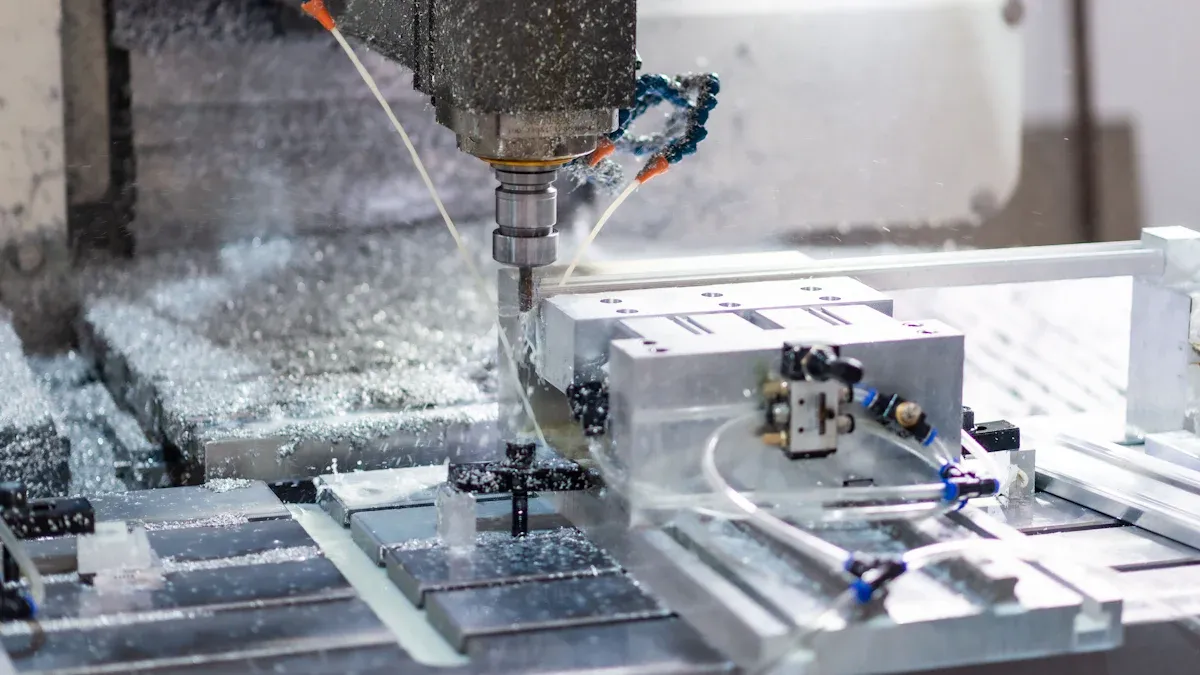
The 5-axis machining center significantly enhances the production of CNC complex parts by allowing simultaneous movement along multiple axes. This capability leads to improved precision, which is crucial in modern manufacturing. Industries such as aerospace, automotive, and medical have experienced measurable improvements due to advanced CNC techniques. For instance, employing 5-axis milling strategies can reduce production lead times by as much as 75% for small batch sizes. This efficiency enables manufacturers to meet tight tolerances and produce intricate geometries with remarkable accuracy, making multi-axis precision machining an essential aspect of contemporary manufacturing. Additionally, for those looking for CNC complex geometry tips, leveraging these advanced techniques can further optimize production processes.
Key Takeaways
- 5-axis machining allows for complex geometries to be produced in a single setup, reducing setup time and minimizing errors.
- This technology enhances precision and accuracy, achieving tight tolerances essential for industries like aerospace and medical.
- Manufacturers can experience up to 75% reduction in production lead times for small batch sizes by using 5-axis machining.
- Investing in advanced CAM software and skilled operators is crucial for overcoming programming challenges in 5-axis machining.
- Adopting 5-axis machining can lead to significant cost savings through reduced scrap rates and lower labor costs.
Understanding 5-Axis Machining
Definition and Mechanism
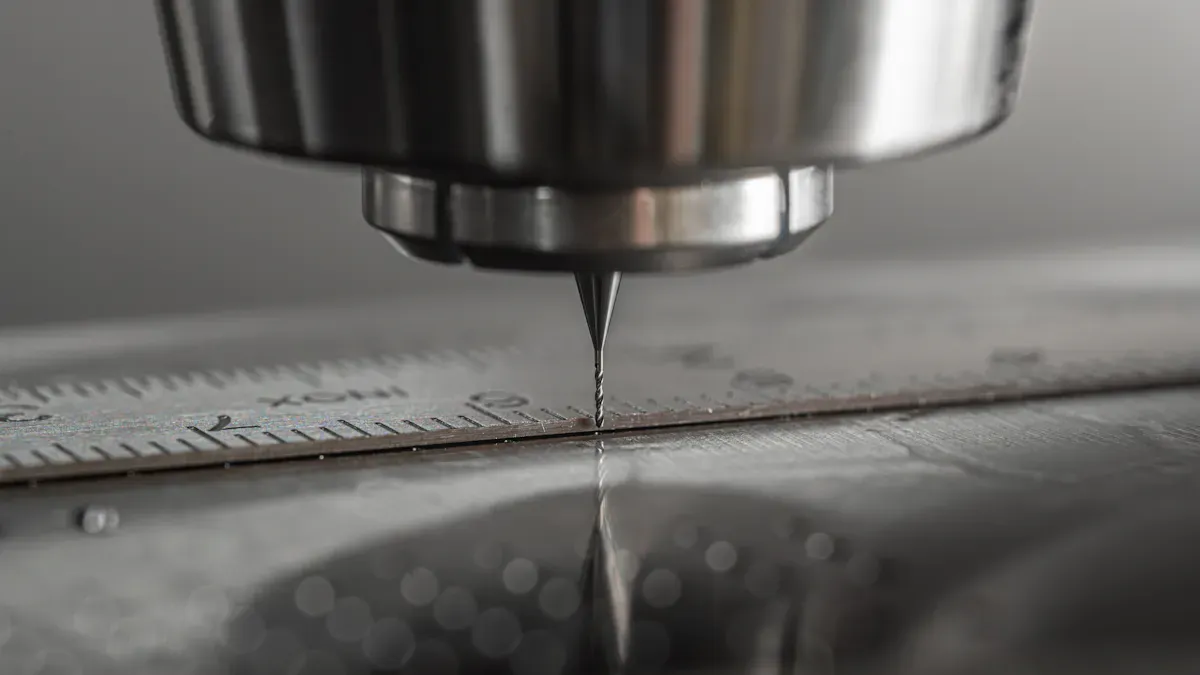
5-axis machining refers to a process that allows tools to move along five different axes simultaneously. This capability enables the creation of complex geometries in a single setup, significantly enhancing efficiency and precision. The mechanism of 5-axis machining differs from traditional methods, such as 3-axis machining, in several key aspects:
| Feature | 5-Axis Machining | 3-Axis Machining |
|---|---|---|
| Movement | Moves in five directions (3 linear + 2 rotational) | Moves in three linear directions |
| Setup | Single setup for complex parts | Multiple setups required |
| Complexity of Parts | Capable of intricate shapes and angles | Limited to simpler shapes |
| Material Waste | Reduced material waste | Higher material waste |
| Tool Movement | Simultaneous movement of all axes | Sequential movement of axes |
| Applications | Turbine blades, medical implants | General milling and turning |
5-axis machining centers utilize both linear and rotational movements, allowing for intricate designs that would be challenging or impossible with 3-axis systems. This advanced capability reduces the need for multiple setups, thus minimizing production time and material waste.
Types of 5-Axis Machines
Several types of 5-axis machines exist, each designed for specific applications and configurations. Understanding these types helps manufacturers select the right machine for their needs:
| Machine Type | Configuration Description | Applications |
|---|---|---|
| Trunnion-Style 5 Axis CNC Machine | Features a tilting rotary table fixed on linear axes, allowing for high rigidity and precision. | Common in aerospace and automotive industries. |
| Swivel Head 5 Axis CNC Machine | Rotates around the spindle, enabling access to various angles without moving the workpiece. | Ideal for small to medium parts with undercuts. |
| Table-Table 5 Axis CNC Machine | Utilizes two rotary tables to position large, heavy workpieces with minimal spindle movement. | Suitable for large, heavy parts requiring stability. |
| Head-Table 5 Axis CNC Machine | Combines a rotating spindle with a tilting table for complex geometries. | Favored in aerospace, medical, and mold components. |
| Gantry-Type 5 Axis CNC Machine | Employs a moving bridge for large parts, ensuring precision through stiffened frames. | Used in aerospace, automotive, and industrial molds. |
Each type of machine offers unique advantages. For example, the trunnion-style machine excels in rigidity, making it suitable for complex parts. The swivel head machine enhances access for smaller components, while the table-table configuration provides stability for heavy workpieces.
Advantages of 5-Axis Machining
Increased Precision and Accuracy
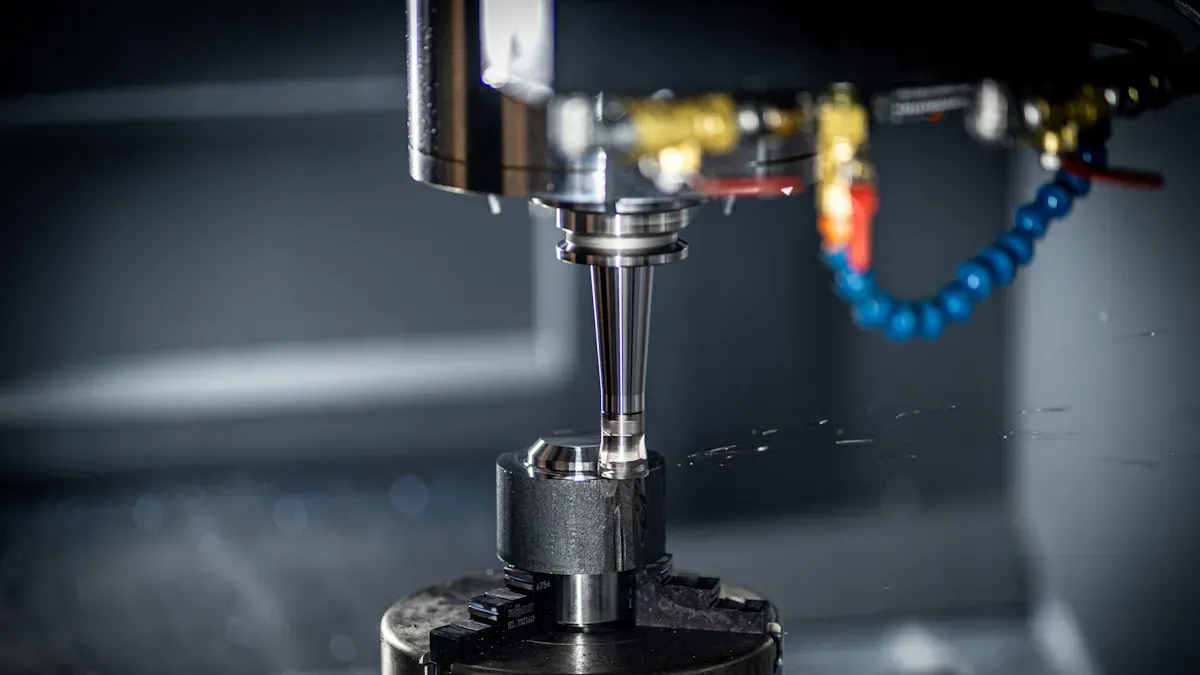
5-axis machining significantly enhances precision and accuracy in manufacturing complex parts. This technology achieves tight tolerances, which is essential in regulated industries such as aerospace and medical. The elimination of repositioning errors leads to higher overall part accuracy. As one expert noted,
“The power of a single setup (‘Done-in-One’) is perhaps the single greatest advantage of 5-axis machining for accuracy. By eliminating re-fixturing, tolerance stacking is virtually eliminated, leading to a much higher overall part accuracy.”
Quantitative studies support these claims, showing that the optimized Dual-NURBS method achieves a maximum chord error of just 0.000379 mm, compared to 0.001207 mm in traditional methods. This improvement reflects better path tracking and overall precision, making 5-axis machining a preferred choice for intricate designs.
Reduced Setup Time
Another significant advantage of 5-axis machining is the reduction in setup time. Manufacturers report that they can achieve 60-80% fewer setups compared to traditional 3-axis machining for complex parts. A part that might require eight setups on a traditional machine can often be completed in just one or two setups on a 5-axis machining center.
Industry data reveals that manufacturers using continuous 5-axis strategies achieve 30% faster cycle times while reducing setup errors by 85%. The following table illustrates the difference in setup requirements between 3-axis and 5-axis machining:
| Manufacturing Approach | Required Setups | Setup Time | Error Potential | Total Production Time |
|---|---|---|---|---|
| 3-Axis Machining | 5-7 setups | 4-6 hours | High | 12-18 hours |
| 5-Axis Machining | 1-2 setups | 1-2 hours | Low | 6-8 hours |
This efficiency not only saves time but also reduces labor costs associated with machine setup, allowing manufacturers to allocate resources more effectively.
Enhanced Tool Life
5-axis machining contributes to enhanced tool life, which is a critical factor in maintaining production efficiency. Studies indicate that tool life can increase by up to 25% when using 5-axis machining techniques. This improvement results from reduced setup times, minimized air-cutting times, and lower rework rates.
By optimizing cutting paths and closely nesting parts, 5-axis machining enhances material efficiency, leading to less scrap material. This practice not only benefits manufacturers economically but also supports sustainable manufacturing by minimizing waste.
Comparison with 3-Axis Machining
Limitations of 3-Axis Machining
3-axis machining serves well for basic geometries, such as flat surfaces or drilled holes. However, it encounters significant limitations when addressing complex geometries. The following table outlines the primary limitations of 3-axis machining:
| Limitation | Description |
|---|---|
| Undercut Access | 3-axis machining cannot access undercut structures, blocking vertical tool access, making machining impossible. |
| Setup Complexity | This method requires multiple setups for complex geometries, which can lead to cumulative errors. |
| Fixed Tool Orientation | The fixed tool axis restricts machining of angled or contoured surfaces, limiting design flexibility. |
These limitations hinder the ability to produce intricate parts efficiently. As a result, manufacturers often face increased production times and higher costs due to the need for multiple setups.
Advantages of 5-Axis Over 3-Axis
5-axis machining centers offer distinct advantages over their 3-axis counterparts. The ability to perform continuous machining with a single clamping setup significantly reduces positioning errors. This capability is crucial for maintaining strict tolerances and achieving excellent surface finishes, particularly on curved surfaces.
Moreover, 5-axis machining allows tools to approach parts at optimal angles, which is essential for reaching undercuts and complex features. This leads to fewer setups and improved precision across contoured surfaces. For medium-to-low volume, high-complexity, or high-value-added custom parts, 5-axis machining minimizes total manufacturing costs by decreasing the number of setups and shortening delivery cycles.
The following table summarizes the performance differences between 3-axis and 5-axis machining:
| Criteria | 3-Axis Machining | 5-Axis Machining |
|---|---|---|
| Setup Requirement | Multiple setups for complex parts | Usually single-setup machining |
| Surface Finish | May need secondary finishing | Produces smoother surfaces directly |
| Cycle Time | Longer on complex parts | Reduced due to fewer setups |
By completing parts in a single setup, 5-axis machining maintains uniform reference points. This reduces errors from re-clamping and tool deflection, resulting in higher geometric consistency and improved surface finishes.
Common Challenges in 5-Axis Machining
Complexity of Programming
Programming 5-axis machines presents significant challenges. Operators must navigate the complexities of advanced Computer-Aided Manufacturing (CAM) software. This software is essential for creating toolpaths that coordinate five axes effectively. Key programming challenges include:
- Advanced CAM Software: Operators require specialized software to manage intricate toolpaths.
- Rigorous Simulation: Thorough simulations are necessary to prevent collisions and optimize cutting strategies.
- Skilled Operators: Highly trained personnel are crucial to handle the machine’s complexities and ensure efficient operations.
Traditional 3-axis programmers often need extensive training to master these advanced techniques. Understanding toolpath optimization and machine kinematics becomes vital as part complexity increases.
Tooling and Fixture Considerations
Tooling and fixture design significantly impact the efficiency of 5-axis machining. Proper workholding ensures stability during machining, especially at various tilt angles. Considerations include:
- Secure Support: Workpieces must be securely supported to maintain precision, particularly beneath overhanging areas.
- Optimal Tool Angles: 5-axis machining allows for better tool angles, enhancing surface finishes and accuracy.
- Rigidity in Workholding: Excellent rigidity in workholding systems prevents vibrations, which can compromise part quality.
Quick and consistent setups can be achieved through palletized systems, further enhancing overall efficiency.
Cost Implications
Implementing 5-axis machining involves various cost implications. While the initial investment is higher than simpler processes, the long-term benefits often outweigh these costs. Key points include:
- Reduced Scrap Rates: Scrap rates can decrease by up to 25%, leading to material savings.
- Lower Labor Costs: Labor costs for complex parts can drop by 30-50% due to reduced setup times.
- Increased Efficiency: 5-axis machining minimizes operational costs by allowing complex parts to be produced in a single setup.
Despite the higher initial investment, the return on investment (ROI) can be substantial due to increased productivity, reduced cycle times, and improved part quality.
Future Trends in 5-Axis Machining
Technological Advancements
The future of 5-axis machining is shaped by several technological advancements. Manufacturers increasingly adopt intelligent software and automation to enhance productivity. Key developments include:
- Integration of Intelligent Software: Real-time monitoring systems allow for immediate adjustments during machining processes.
- Adaptive Control Systems: These systems enable higher speeds and precision, optimizing workflow efficiency.
- Advanced CAD/CAM Software: This software facilitates digital simulation and optimization, improving design accuracy.
- Robotic Integration: Automatic tool changers and robotic systems streamline operations, reducing manual intervention.
These advancements can increase productivity by up to 30% and significantly enhance machining precision. For instance, faster cycle times are achieved through tangential cutting, which removes more material per tool rotation compared to traditional methods. Overall machining time can decrease by 25-50% for complex parts, making 5-axis machining more efficient than ever.
Industry Adoption Rates
The adoption of 5-axis machining technology is rising across various sectors. Industries such as aerospace and medical devices particularly benefit from its capabilities. These sectors require maintaining tolerances within sub-micron levels, which is critical for components like turbine blades and surgical instruments.
Key sectors adopting 5-axis machining include:
- Aerospace: High precision for turbine blades and engine components.
- Medical Devices: Essential for implants and surgical instruments requiring tight tolerances.
- Automotive: Used for complex transmission components and engine blocks.
The demand for precision manufacturing drives this trend. As manufacturers seek to reduce production time and costs, the shift towards Industry 4.0 and smart manufacturing encourages upgrades in machining capabilities. This evolution positions 5-axis machining as a vital technology for maintaining competitiveness in high-value production.
5-axis machining offers numerous benefits for producing complex geometries. Key advantages include:
| Benefit | Description |
|---|---|
| Single-Setup Machining | Machining nearly every surface in one setup eliminates risks of misalignment and human error. |
| Faster Cycle Times | Reduces total production time by minimizing manual repositioning, leading to higher throughput. |
| Improved Part Quality and Accuracy | Ensures all features are aligned to a single datum, reducing tolerance errors and improving finish. |
| Enhanced Access to Complex Geometries | Allows for machining of intricate shapes and undercuts that are difficult with 3-axis machines. |
Manufacturers must address challenges such as programming complexity and tooling considerations for successful implementation. Solutions like specialized tools and powerful CAM software can enhance efficiency.
Adopting 5-axis machining provides a competitive edge, enabling manufacturers to improve efficiency, reduce costs, and access high-value markets. Embracing this technology positions businesses for success in a rapidly evolving manufacturing landscape.
FAQ
What is the primary benefit of 5-axis machining?
5-axis machining allows manufacturers to create complex geometries in a single setup. This capability reduces setup time and enhances precision, leading to improved part quality.
How does 5-axis machining differ from 3-axis machining?
5-axis machining moves along five axes simultaneously, while 3-axis machining only moves along three. This difference enables 5-axis machines to handle more intricate designs and reduce repositioning errors.
What industries benefit most from 5-axis machining?
Industries such as aerospace, automotive, and medical devices benefit significantly from 5-axis machining. These sectors require high precision and the ability to produce complex parts efficiently.
Are there any challenges associated with 5-axis machining?
Yes, challenges include programming complexity, tooling considerations, and higher initial costs. Manufacturers must invest in skilled personnel and advanced software to overcome these hurdles.
How can manufacturers improve their 5-axis machining processes?
Manufacturers can enhance their processes by investing in advanced CAM software, training operators, and optimizing tooling and fixture designs. These steps can lead to increased efficiency and reduced production costs.
Post time: Mar-17-2026