


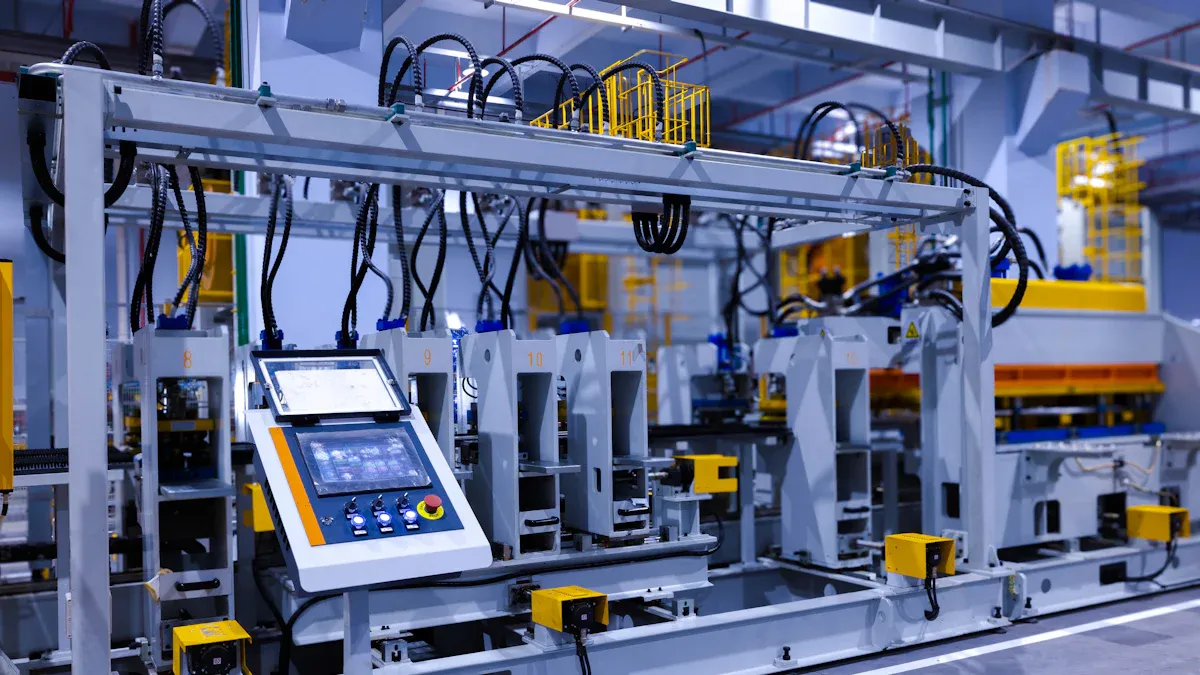
Manufacturing operations continuously seek to maximize production efficiency with their Horizontal Cnc Milling Machine. Achieving superior part quality and reducing operational costs remain paramount objectives for businesses. Companies effectively future-proof their operations for competitive advantage by optimizing their equipment. An Industrial Cnc Milling Machine offers robust capabilities for diverse applications. A Multi Axis Cnc Machine significantly enhances complex part production. High Precision Cnc Milling Machine technology provides critical accuracy. Leading Cnc Milling Machine Manufacturers focus on delivering innovative solutions. Optimizing your Horizontal Cnc Machine ensures sustained productivity.
Key Takeaways
- Improve machine accuracy and reduce setup time. Use good fixtures and keep the machine area clean.
- Use advanced software to plan tool paths. This helps make complex parts faster and avoids mistakes.
- Manage tools smartly and pick the right materials. This makes tools last longer and saves money.
- Make production smoother and faster. Use multi-sided machining and quick cutting methods.
- Prepare your machine for the future. Use 3+2 machining and always look for ways to improve.
Foundational Optimization for Your Horizontal Cnc Milling Machine
Reducing Setups and Enhancing Accuracy
Optimizing a Horizontal Cnc Milling Machine begins with foundational strategies. Reducing the number of setups significantly improves efficiency. Each setup introduces potential for error and consumes valuable time. Manufacturers achieve higher accuracy by minimizing part re-orientations. This approach also reduces the risk of human error during part handling. Fewer setups lead directly to faster production cycles and more consistent part quality. Operators can focus on machining rather than repeated adjustments.
Precision Fixturing and Workpiece Alignment
Precision fixturing is critical for consistent results. Securely holding the workpiece prevents movement during machining. This ensures the tool follows the programmed path accurately. Proper workpiece alignment also plays a vital role. Misaligned parts lead to dimensional inaccuracies and scrap. Investing in high-quality fixtures and implementing rigorous alignment procedures pays dividends. These practices directly contribute to achieving tight tolerances and superior surface finishes. They also extend tool life by preventing uneven wear.
Optimal Machine Environment and Calibration
Maintaining an optimal machine environment is essential for performance. High humidity and ambient heat pose significant challenges for CNC machines. This particularly affects those with enclosed cabinets or integrated automation. Implementing environmental adjustments effectively protects equipment and improves shop performance. Maintaining a comfortable and stable temperature within the operating environment of a Horizontal Cnc Milling Machine is crucial. This prevents overheating or excessive cooling, thereby ensuring the quality of the final product. This often necessitates the use of air conditioning and heating systems to regulate temperatures across various climates. Operators should maintain a constant temperature in the machining area between 59°F and 77°F. An air conditioning system provides stability, especially for high-precision components. They should also keep humidity levels between 40%–60% RH. This prevents metal oxidation and ensures proper operation of electronic components. Install dehumidification equipment in the workshop, particularly during rainy seasons or in highly humid areas, to control humidity. Regular calibration of the machine also ensures its accuracy over time.
Advanced Software and Toolpath Optimization
Advanced software and toolpath optimization significantly elevate the performance of a Horizontal Cnc Milling Machine. These technologies unlock new levels of precision, efficiency, and automation. They allow manufacturers to tackle complex geometries with greater confidence and speed.
CAM Programming for Multi-Axis Machining
Computer-Aided Manufacturing (CAM) programming forms the backbone of modern multi-axis machining. It translates complex designs into precise machine instructions. Advanced CAM software offers powerful capabilities for optimizing toolpaths and machine movements.
- Multi-axis machining handles complex geometries effectively. It reduces setups, improves tool access, and achieves superior surface finishes. Software like Siemens NX CAM provides robust 5-axis programming strategies, including collision avoidance and machine simulation.
- Automated toolpath generation intelligently analyzes part geometry. It creates efficient toolpaths automatically. Examples include feature-based machining, adaptive clearing for constant chip load, and high-speed machining for smooth, flowing toolpaths. This reduces programming time, improves tool life, and ensures consistent results.
- Integrated simulation validates CNC programs before machining. It prevents errors, optimizes toolpaths, and avoids collisions. Key capabilities include machine simulation (detecting collisions between machine components), material removal verification (checking for gouges or undercuts), and G-code simulation (accurate representation of the final program).
- Postprocessing translates CAM toolpaths into machine-ready G-code. This code is specific to each machine and control. Advanced CAM software offers customizable output, control-specific optimization, and integration with machine simulation for G-code level verification.
- CAD/CAM integration seamlessly connects with CAD software. CAM works directly with native CAD models. Benefits include associativity (changes in CAD reflect in CAM), feature recognition (CAM accesses CAD features for automated programming), and design for manufacturability (facilitating communication between design and manufacturing teams).
Advanced CAM programming also dramatically reduces cycle times in 5-axis horizontal milling. Manufacturers achieve 30-50% faster cycle times compared to basic toolpath strategies.
- Rest Machining programs the toolpath to cut only remaining material after previous operations. This reduces unnecessary cuts.
- Morph Between Boundaries creates smooth transitions between cutting regions. It improves efficiency.
- Constant Scallop Height maintains uniform stepover across curved surfaces. This optimizes material removal.
- Adaptive Tool Axis presents more flute length to the material for deeper cuts. This leads to faster material removal.
- Helical Entry reduces shock loading on the tool. It contributes to smoother and faster operations.
- Trochoidal or Dynamic Milling effectively removes heavy material. It speeds up roughing passes.
- Adjust Radial Engagement to 40-50% of tool diameter. This allows for significantly increased feed rates while maintaining tool life.
- Control Tool Axis Position relative to the surface normal. This presents fresh cutting edges. It enables deeper axial cuts and reduces side loading.
- Enable Stock Recognition. Modern CAM software avoids cutting areas already machined. This eliminates wasteful air cutting.
- Boundary-Based Programming allows aggressive settings in open areas. It uses conservative parameters near critical features. This optimizes speed where possible.
- Tool Axis Smoothing prevents sudden jerky movements. It creates smooth transitions between tool orientations. This contributes to faster and more stable machining.
- Cusp Height Management balances surface quality and cycle time. Accepting a small consistent cusp height (e.g., 0.001-0.003 inches for ball-nose end mills) reduces the number of passes needed.
- Simultaneous 5-axis programming allows the tool to maintain optimal contact throughout the cut. This is crucial for finishing complex sculptured surfaces efficiently.
- Collision Detection Refinement verifies that the entire tool assembly clears the part. It prevents crashes and allows for more aggressive, yet safe, toolpaths.
- Strategic Stepover Selection optimizes stepover distance. It balances finish quality and cycle time. Smaller stepovers do not linearly increase cycle time due to less time spent changing direction.
- Feed Rate Adjustment maintains consistent feed rates. It uses smoothing features for gentle acceleration and deceleration curves. This prevents marks and ensures efficient material removal.
Advanced CAM systems support cutting tools like circle segment cutters and multi-flute endmills. These tools significantly reduce both roughing and finishing cycle times. Programming in the tool shape allows the system to automatically generate tool paths with larger stepovers. This maintains or improves machining tolerance. It also reduces the need for blending, matching, and stitching. Modern CNCs with advanced ‘lookahead’ technology dynamically adjust feed rates for tight corners and curves. This enables accurate 5-axis machining at higher feed rates, dramatically reducing cycle times.
Simulation and Collision Detection for Efficiency
Simulation software plays a vital role in ensuring efficiency and safety in 5-axis machining. It provides a virtual environment for testing and refining machining processes.
- Simulation helps avoid collisions between the tool and the workpiece. This is a higher risk in 5-axis machining due to complex, dynamic movements.
- It enables programming and debugging of machining applications in a virtual environment. This occurs before physical production.
- Simulation detects collisions between the hybrid machine and the additive part. It flags voids, errors, and misplaced material.
- It supports 5-axis milling, turning, and additive laser sintering.
- Simulation simulates full G-code programs for hybrid CNC machines. It helps reduce costly trial-and-error. It also improves part quality, shortens development cycles, and ensures process reliability. It detects potential defects like warping or overheating early.
- Simulation detects errors, eliminates collisions, and removes the need for manual prove-outs.
- It provides an accurate representation of machine actions, especially in full 5-axis operations.
- Simulation saves time by eliminating the need to prove out complex code manually.
- It serves as a tool for double-checking posted code.
- Simulation acts as a type of insurance, particularly for less experienced operators.
- It incorporates collision detection directly into the path-planning stage. This allows for the design of highly accurate, collision-free tool motions.
- Simulation guarantees collision detection with a fast collision test embedded in the path-planning stage.
Digital Twin Integration for Process Control
Digital twin integration revolutionizes process control and predictive maintenance for horizontal CNC mills. A digital twin is a virtual replica of a physical asset. It provides real-time insights and predictive capabilities.
- Continuous Real-Time Data Collection: Sensors embedded in machines track temperature, vibration, pressure, operational speed. They feed data into the digital twin. This enables early detection of issues like overheating or abnormal vibrations.
- Integration of Operational and Maintenance Data: Digital twins combine sensor data with maintenance logs and historical performance data. This comes from systems like ERP and CMMS. It provides a comprehensive view of asset health for more accurate and timely predictive maintenance.
- Advanced Simulation and Predictive Analytics: Simulation engines model asset behavior under various conditions. Machine learning algorithms then forecast potential failures. This allows for timely interventions and prevents unplanned downtime.
- Predictive Models Trigger Maintenance Alerts: When anomalies occur (e.g., abnormal temperature or vibration), predictive models generate alerts. This enables proactive maintenance scheduling before failure. It shifts maintenance from reactive to proactive.
- Real-Time Feedback and Continuous Improvement: Digital twins continuously update with new data. They refine their predictions and enhance accuracy. This continuous learning ensures maintenance decisions rely on the most current asset conditions. It improves asset lifespan and operational efficiency.
For horizontal CNC mills, digital twin integration specifically enhances process control and predictive maintenance through a multi-dimensional approach.
- Core Implementation Framework:
- Data Acquisition Layer: IoT sensors deploy for vibration, temperature, pressure, spindle motor current, load, and positional errors. Real-time data from servo motors and cutting tools feeds the digital twin.
- Modeling Layer: Physics-based models (e.g., finite element for spindle dynamics) combine with data-driven methods (e.g., deep learning for wear prediction).
- Synchronization Layer: Bidirectional mapping ensures via edge-server collaboration or cloud platforms. This provides real-time updates with low latency.
- Analytics & Control Layer: ML models (e.g., regression for tool life, Bayesian filtering) predict faults and simulate interventions for optimization.
- Performance Optimization Strategies:
- Vibration & Precision Control: Digital twins simulate stiffness, damping, and error motion using real-time sensor data. They optimize feed rates and spindle speeds. This reduces chatter and improves accuracy.
- Dynamic Adjustment: Autonomous digital twin strategies adjust parameters like cutting conditions for stability. This relies on multi-domain unified modeling.
- Predictive Maintenance Implementation:
- Tool Wear/Fault Prediction: Hybrid digital twin models forecast remaining useful life (RUL). They use vibration signatures and motor currents. Physics-informed neural networks enforce physical constraints for accuracy.
- Spindle/Component Health: Physics-informed digital twins detect damage or precision loss. They predict productivity through dynamic models synchronized with machine status.
- Workflow: This includes sensor network setup, ML training for identification and verification, and RUL simulation. It leads to alerts for faults within minutes.
Intelligent Tool Management and Material Selection
Optimized Tool Selection for Complex Parts
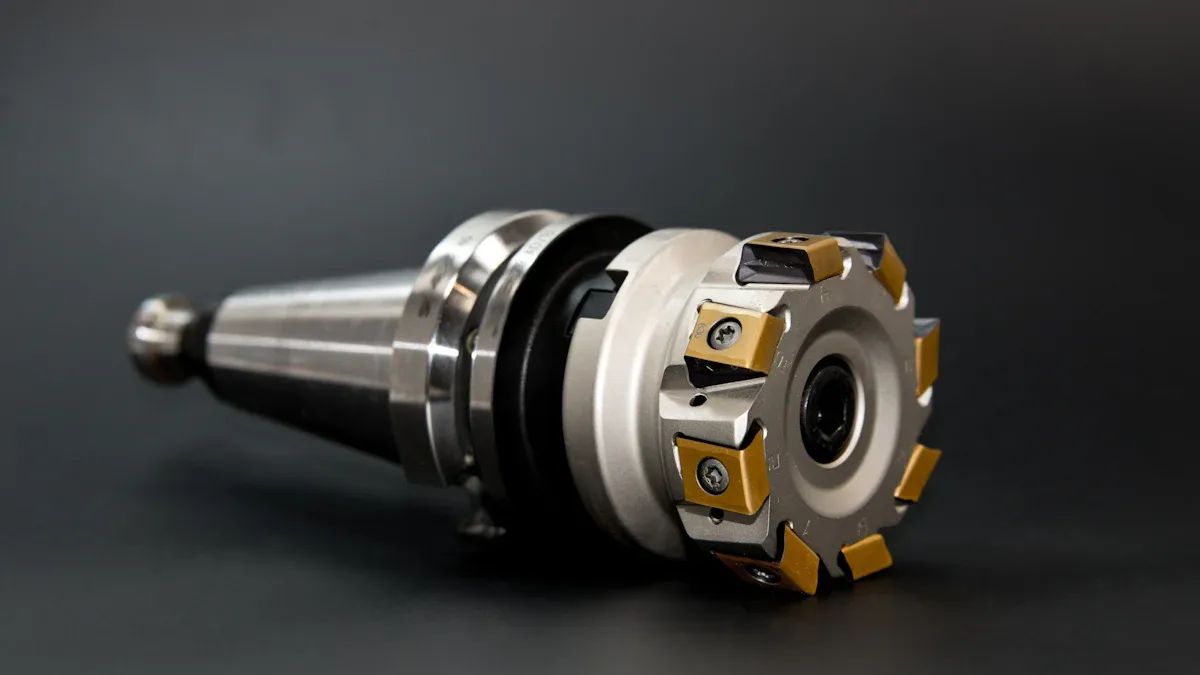
Selecting the right cutting tools significantly impacts the performance of a Horizontal Cnc Milling Machine. For complex parts, manufacturers must choose tools that offer precision and durability. Optimal tool coatings are crucial for extending tool life in specific material applications. Coatings provide essential properties like wear resistance, maintaining sharpness during prolonged use. They also act as a thermal barrier, allowing tools to withstand high temperatures generated during machining. Furthermore, coatings enhance lubricity, which reduces friction and improves chip evacuation.
The material being cut dictates the suitable coating. For example, different coatings work best for steel up to HRC 52, hardened steels above HRC 60, or high-temperature alloys. Machining conditions, such as speed (medium, high, low) and whether the process is wet or dry, also influence the choice.
Predictive Tool Wear Monitoring
Implementing predictive tool wear monitoring systems offers substantial economic benefits. These systems extend machinery life by aligning service schedules with actual operational usage trends. They ensure continuous production by preventing expensive and unexpected shutdowns. Predictive monitoring drastically reduces upkeep costs by optimizing maintenance frequency and focusing on repairs only when needed. This approach prevents minor problems from escalating into significant damage through early detection. It maximizes the useful life of each component and minimizes unnecessary capital investments by reducing premature replacement needs.
| Benefit | Impact |
|---|---|
| Downtime | Reduced by 35–50% |
| Asset Lifespan | Increased by 20–40% |
| Maintenance Expenses | Decreased by 20–30% |
| Unplanned Downtime | Decreased by 30–40% |
Predictive maintenance significantly reduces costs by preventing unplanned downtime and catastrophic failures. Manufacturing downtime can cost facilities up to $150,000 per hour. Using sensors and condition-monitoring techniques detects potential failures early, minimizing these losses.
Right Tools and Materials for Production
Choosing the right tools and materials is fundamental for efficient production. The coating should be selected based on the material being worked with, such as hardened steel, titanium, or cast iron. Manufacturers generally avoid coatings that include the material being cut in their chemical composition. The specific machining operation, like drilling, milling, or tapping, also influences the coating choice. Coatings can increase tool strength, improve lubricity for better chip removal, and enhance resistance to heat. This careful selection ensures optimal performance and extends the lifespan of cutting tools.
Streamlining Production and Process Efficiency
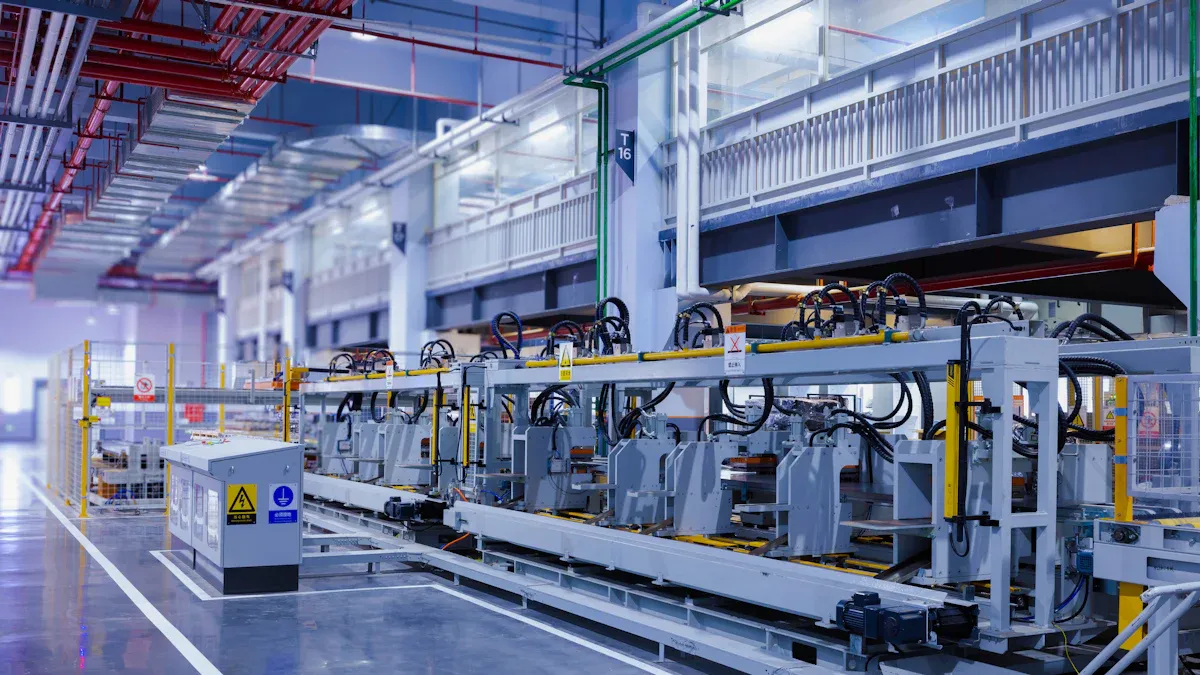
Manufacturers continuously seek methods to enhance production and process efficiency. Optimizing a Horizontal Cnc Milling Machine involves strategic approaches that reduce operational time, improve quality, and maximize throughput. These strategies ensure competitive advantage in a demanding market.
Multi-Sided Machining Strategies
Multi-sided machining strategies significantly reduce part handling and improve accuracy. This approach allows a machine to access multiple faces of a workpiece in a single setup.
- Enhanced Precision: Machining from multiple angles in one setup ensures tighter tolerances and higher accuracy. This is crucial for meeting strict industry standards.
- Greater Efficiency & Reduced Setup Time: Eliminating the need to manually reposition a workpiece saves both time and labor. All sides of a part machine without stopping to reset the material. This leads to fewer errors and higher throughput.
- Lower Risk of Human Error: Automated multi-axis systems minimize manual intervention. This decreases the chances of mistakes and improves consistency across production runs.
Multi-axis CNC machines significantly reduce part handling. They allow complex geometries to be machined in a single setup without repositioning the workpiece. This directly improves accuracy because each time a workpiece moves, precision compromises. By minimizing these movements, multi-axis machines maintain precision, deliver accurately machined and smoother parts, and reduce errors prevalent in conventional 3-axis machines.
Multi-axis machining enhances precision and accuracy. It enables multiple operations within a single machine setup. This approach is cost-effective and saves time by eliminating the need for repositioning. This single setup reduces errors, sustains constant accuracy, and provides better tolerance and cutting control. Additionally, it reduces the need for fixtures, as the workpiece remains in place with fewer chances of displacement. This further contributes to good precision.
Multi-axis CNC machining produces complex parts in a single setup. This significantly reduces the number of processes and machines required. It raises the overall geometrical accuracy of the final part. This single-setup capability means repositioning is not needed to create features on multiple planes of a workpiece. It further enhances accuracy by lowering the risk of human error associated with manual adjustments and repositioning during production.
Cycle Time Reduction Techniques
Optimizing tool paths offers significant cycle time reductions in 5-axis milling. Manufacturers employ various advanced techniques to achieve this efficiency.
- Intelligent Roughing Strategy: This strategy incorporates techniques like pendulum milling. Pendulum milling involves continuous cutting with a helical trajectory, reducing lateral force for deep cavities. Dynamic milling maintains a constant cutting thickness and increases feed rates up to three times conventional methods. This strategy can reduce roughing time by 40% and extend tool life by 20%.
- Finishing Path Optimization: This utilizes methods such as equal residual height machining. This automatically adjusts step spacing based on surface curvature for consistent roughness. Streamline machining involves the tool following the surface vector direction to reduce machine vibration. One case study showed automotive mold finishing time reduced from 8 hours to 5 hours.
- Multi-axis Linkage Path Planning: This includes 5-axis side edge machining. It uses the tool’s side edge for complex surfaces, increasing efficiency by 50%. It also features 3+2 positioning machining, which reduces clamping times and improves accuracy by 0.02mm. Collision avoidance algorithms provide real-time interference simulation.
- Tool Load Balancing Technology: This employs data-driven approaches. It monitors cutting force via sensors to dynamically adjust feed rates. For example, it automatically reduces speed by 10% when the load exceeds limits. It also uses adaptive cutting parameter libraries for different materials.
- Intelligent Identification of Residual Machining: This involves creating residual material maps. It automatically identifies uncleared areas from previous processes for targeted make-up cuts. A small tool priority strategy, such as a 2mm tool for corner cleanup, avoids idle time for a 10mm tool.
Adaptive feed-rate scheduling strategies enhance the efficiency of trochoidal milling. These strategies allow for adjustments based on real-time conditions, thereby contributing to cycle time reduction.
| Metric | Conventional Milling | Trochoidal Milling |
|---|---|---|
| Axial Depth | 0.01 inches (19 passes) | 0.190 inches (1 pass) |
| Material Removal Rate | Baseline | Increased by >90% |
| Cycle Time Reduction | N/A | 134 minutes (58%) |
| Machining Capacity Freed | N/A | 4,540 hours |
Trochoidal milling offers significant advantages. Strategy 2, using G02/G03 commands with stepover modulation, shortened tool path length and machining time by 33% compared to Strategy 1. Integrating G02 and G03 commands, along with excluding non-cutting regions, led to substantial reductions in tool path length and overall machining time.
In-Process Quality Control and Finishes
Effective in-process quality control and superior finishes are critical for high-value parts. Advanced technologies provide real-time monitoring and precision.
- Real-time, Remote Data: Smart 5-axis machining capabilities enable machines to feed data to enterprise systems and monitoring programs. This provides visibility and analysis for predictive maintenance, bottleneck identification, and efficiency improvements.
- Connected Machining: Systems like HEIDENHAIN’s ensure all production processes are networked, from design to delivery. This includes tool management, scheduling, real-time machine status dashboards, quality assurance, and historical data collection.
- Adaptive Feed Control (AFC): This practical form of AI significantly increases feed rates during air cuts and reduces them when the cutter meets material. It leads to substantial cycle time savings.
- ‘Look Ahead’ Capabilities: These include contour deviation monitoring and vibration mitigation. They are practical forms of AI contributing to process control.
- Touch Probe Verification: This automates and expedites verification tasks, especially for complex parts. It adds probes to tool carousels, reducing human error and improving efficiency.
Advanced measurement technologies further enhance quality control.
- 5-Axis CMM Technology: This improves access to features at all angles. It minimizes CMM major structure movement and increases speed and accuracy through techniques like ‘head touch’ and ‘infinite positioning’.
- Head Touch: This probing technique primarily uses head movement to trigger points. It reduces dynamic errors and improves accuracy and repeatability at higher measurement speeds.
- Infinite Positioning: This enhances productivity and flexibility. It allows the probe head to move freely and align with the part coordinate system. This minimizes stylus changes and collision risks.
- Inferred Calibration: This productivity benefit determines head orientation and probe position in a single operation. It allows subsequent measurement at any head angle with minimal calibration for additional probe tips.
- Verisurf Custom Techniques: These include specialized scanning methods like Curve Scan (for transitional surfaces), Pocket Scan (for isogrid/orthogrid structures), and Spiral Scan (for turbine blades/propellers). They improve speed and accuracy.
- Advanced 5-Axis Sensors (Renishaw REVO®):
- RVP (Vision Probe): For 5-axis non-contact structured light measurement of complex surfaces with automatic exposure compensation.
- RUP1 (Ultrasonic Probe): For automated 5-axis ultrasonic thickness measurement (1 mm to 20 mm range, 10 micron accuracy).
- SFP2 (Surface Finish Probes): For significant time savings, reduced part handling, access to difficult areas, and integrated surface finish measurement reports.
Achieving superior surface finishes on complex geometries using 5-axis horizontal CNC mills requires specific best practices.
- Optimize Feeds and Speeds: Use high spindle speeds and low feed rates to reduce tool deflection and minimize vibration. Consider material properties, as aluminum benefits from higher speeds. Employ climb milling.
- Use High-Quality Cutting Tools: Opt for carbide or diamond-coated tools with appropriate geometry. Sharper tools suit soft materials, while rigid tools suit hard metals. Ensure regular maintenance.
- Leverage Advanced CNC Software: Utilize modern software for toolpath simulation and motion optimization. This prevents errors leading to poor finishes.
- Ensure Proper Workpiece Fixturing: Prevent vibrations and misalignment by using soft jaws or custom fixtures. Minimize overhang and check alignment.
- Select the Right Coolants and Lubricants: Use flood coolant for materials like aluminum. Mist lubrication suits high-speed machining. Specialized fluids dissipate heat and evacuate chips.
- Fine-Tune Cutting Depth and Width: Employ light finishing passes, typically below 0.010 inches for the final pass. Ensure slight overlap in toolpaths to avoid visible lines.
- Utilize Post-Machining Techniques: When necessary, apply polishing, deburring, anodizing, or plating to refine the surface.
- Optimize Machine Settings for Consistency: Ensure the CNC machine is well-calibrated to produce consistent results.
- Match the Material to the Application: Understand material-specific challenges. Aluminum galls, steel chatters, and plastics deform. Apply appropriate solutions, such as sharp tools and flood coolant for aluminum, or rigid tools and slow feeds for steel.
- Monitor and Analyze Results: Consistently check surface quality using tools like surface profilometers, visual inspections, and customer feedback to refine processes.
Five-axis machines achieve superior surface finishes on complex parts like turbine blades. They maintain continuous tangential tool contact with part surfaces. This optimized cutting geometry significantly reduces vibration and chatter, common causes of surface defects in 3-axis machining. As a result, these parts require minimal secondary finishing. They often become ready for coating and assembly directly from the machining center. This reduces manufacturing costs and cycle times while maintaining tighter dimensional tolerances. This capability is particularly valuable for aerospace and medical applications where surface finish directly impacts functionality and regulatory compliance.
Future-Proofing Your Horizontal Cnc Milling Machine Operations
Manufacturers must continuously adapt and innovate to maintain a competitive edge. Future-proofing a Horizontal Cnc Milling Machine involves adopting advanced techniques and methodologies. These strategies ensure long-term efficiency, quality, and adaptability.
Leveraging 3+2 Machining for Efficiency
Leveraging 3+2 machining offers significant efficiency improvements for specific part types. This method positions the workpiece in two rotational axes and then performs 3-axis machining. It provides a more accessible entry point into 5-axis work with lower initial costs and faster programming setup.
- Lower Programming Complexity: This approach involves less spatial trajectory and rotational motion. It makes programming free-form surfaces more accessible compared to simultaneous 5-axis machining.
- Reduced Costs and Cycle Times: The method eliminates the need to stop the spindle multiple times for different surfaces. It allows work on five different surfaces at a time. This significantly improves over traditional 3-axis methods.
- Fabricates More Intricate Features: It allows the use of shorter, more rigid cutting tools. This enables the fabrication of steep walls, undercuts in cavities, and other complex features. It also increases tooling lifespan and achieves precision.
3+2 machining works well for plane processing projects and parts with features on multiple sides. It is particularly effective for:
- Workpieces creating challenging cutting conditions for simultaneous 5-axis machining.
- Machining certain types of parts from solid instead of complex castings.
- Prototype work.
- Drilling holes at compound angles in a single setup.
- Deep cavities in complex molds.
| Efficiency Aspect | 3+2 Machining | Full 5-Axis Simultaneous Machining |
|---|---|---|
| Programming Requirements | More accessible programming for free-form surfaces. | More complex programming due to simultaneous movement. |
| Cost & Cycle Times | Reduces need to stop spindle multiple times, leading to reduced costs and cycle times for certain applications. | Can be less efficient for parts not requiring full simultaneous movement. |
| Tooling & Features | Allows use of shorter, more rigid tools for fabricating steep walls, undercuts, and complex features. | Capable of intricate features, but 3+2 offers specific advantages for tool rigidity and access. |
Combining Specialized Tools for Enhanced Production
Combining specialized tools significantly enhances production rates. These tools are designed for specific, complex geometries. For example, “Blade Expert” is an add-on designed for multi-blade configurations. It facilitates faster toolpath generation and enhances accuracy. “Port Expert” simplifies the programming process for cylinder head ports. These specialized tools streamline operations and improve output quality.
Continuous Improvement and Adaptability
Continuous improvement and adaptability are vital for any Horizontal Cnc Milling Machine operation. Manufacturers implement methodologies like Lean and Six Sigma to optimize processes. They often utilize the DMAIC (Define, Measure, Analyze, Improve, Control) framework. Lean identifies and eliminates waste. Six Sigma provides statistical tools to reduce variation and defects.
For instance, during the Measure phase, Value Stream Mapping (a Lean tool) can be used alongside Statistical Process Control (a Six Sigma technique). This provides deeper insights into production issues. The DMAIC framework guides teams through problem-solving. It defines the problem, collects baseline data, identifies root causes, and develops solutions. Specific applications include setup time reduction using SMED, quality control with SPC, and waste reduction strategies. Six Sigma methodologies also optimize CNC parameters like feed rates, spindle speeds, and cutting depths. This reduces cycle time while maintaining product quality. It integrates error-proofing mechanisms (Poka-Yoke) into automated systems. This prevents potential defects. Data from CNC machines is continuously analyzed within Six Sigma frameworks. This improves processes, reduces cycle times, and eliminates bottlenecks.
Manufacturers implement these key strategies for 5-axis horizontal CNC mill optimization. These actions drive significant improvements in productivity and part quality. This positions their manufacturing for sustained success in 2025 and beyond.
- Foundational Optimization enhances machine accuracy and reduces setups.
- Advanced Software streamlines complex programming and prevents errors.
- Intelligent Tool Management extends tool life and optimizes material use.
- Streamlined Production boosts efficiency and ensures superior finishes.
- Future-Proofing ensures adaptability and competitive advantage.
FAQ
What is the primary benefit of optimizing a 5-axis horizontal CNC mill?
Optimizing a 5-axis horizontal CNC mill primarily maximizes production efficiency. It achieves superior part quality and reduces operational costs. This approach future-proofs manufacturing operations for competitive advantage.
How does CAM programming enhance multi-axis machining efficiency?
CAM programming translates complex designs into precise machine instructions. It optimizes toolpaths and machine movements. This reduces programming time, improves tool life, and ensures consistent results. It also enables advanced strategies like adaptive clearing.
Why is predictive tool wear monitoring important for CNC operations?
Predictive tool wear monitoring extends machinery life. It aligns service schedules with actual operational usage trends. This prevents expensive, unexpected shutdowns. It also drastically reduces upkeep costs by optimizing maintenance frequency.
What role does 3+2 machining play in future-proofing CNC operations?
3+2 machining offers significant efficiency improvements for specific part types. It provides an accessible entry point into 5-axis work. This method has lower initial costs and faster programming setup. It also allows for more intricate features with shorter tools.
Post time: Dec-30-2025